Find the exact value of each expression. Write the answer as a single fraction. Do not use a calculator. sin (3𝜋/2) tan (-15𝜋/4) - cos (-5𝜋/3)
Table of contents
- 0. Review of College Algebra4h 45m
- 1. Measuring Angles40m
- 2. Trigonometric Functions on Right Triangles2h 5m
- 3. Unit Circle1h 19m
- 4. Graphing Trigonometric Functions1h 19m
- 5. Inverse Trigonometric Functions and Basic Trigonometric Equations1h 41m
- 6. Trigonometric Identities and More Equations2h 34m
- 7. Non-Right Triangles1h 38m
- 8. Vectors2h 25m
- 9. Polar Equations2h 5m
- 10. Parametric Equations1h 6m
- 11. Graphing Complex Numbers1h 7m
3. Unit Circle
Reference Angles
Problem 46
Textbook Question
In Exercises 44–48, find the reference angle for each angle.
-410°
Verified step by step guidance1
Understand that the reference angle is the acute angle formed between the terminal side of the given angle and the x-axis.
Since the given angle is negative (-410°), first find its positive coterminal angle by adding 360° repeatedly until the angle is between 0° and 360°: \(-410° + 360° = -50°\), then add 360° again: \(-50° + 360° = 310°\).
Now, with the positive coterminal angle 310°, determine which quadrant it lies in. Since 310° is between 270° and 360°, it lies in the fourth quadrant.
For angles in the fourth quadrant, the reference angle \(\theta_r\) is calculated as \(\theta_r = 360° - \theta\), where \(\theta\) is the positive coterminal angle. So, \(\theta_r = 360° - 310°\).
Calculate the difference to find the reference angle, which will be an acute angle between 0° and 90°.
Verified video answer for a similar problem:This video solution was recommended by our tutors as helpful for the problem above
Video duration:
2mPlay a video:
0 Comments
Key Concepts
Here are the essential concepts you must grasp in order to answer the question correctly.
Reference Angle
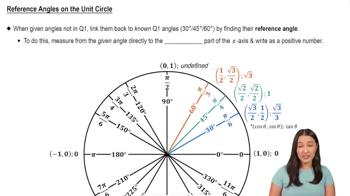
A reference angle is the acute angle formed between the terminal side of a given angle and the x-axis. It is always positive and less than or equal to 90°, used to simplify trigonometric calculations by relating any angle to a corresponding acute angle.
Recommended video:
Reference Angles on the Unit Circle
Coterminal Angles
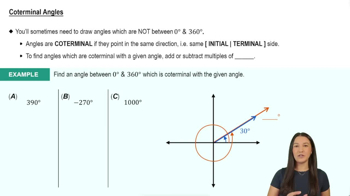
Coterminal angles differ by full rotations of 360°. To find a coterminal angle within the standard 0° to 360° range, add or subtract multiples of 360°. This helps in simplifying angles like -410° by bringing them into a familiar range.
Recommended video:
Coterminal Angles
Quadrants and Angle Positioning
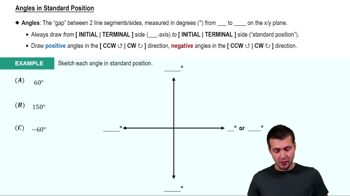
The position of an angle in the coordinate plane (quadrants I-IV) determines how to calculate its reference angle. Knowing which quadrant the angle's terminal side lies in guides the subtraction or addition needed to find the reference angle.
Recommended video:
Drawing Angles in Standard Position
Related Videos
Related Practice
Textbook Question
551
views