In Exercises 44–48, find the reference angle for each angle.- 11𝜋3
Verified step by step guidance
1
insert step 1> Convert the given angle from radians to degrees. Since \( \pi \) radians is equal to 180 degrees, multiply \( \frac{11\pi}{3} \) by \( \frac{180}{\pi} \) to convert it to degrees.
insert step 2> Simplify the expression to find the angle in degrees.
insert step 3> Determine the equivalent angle within the standard 0° to 360° range by subtracting 360° from the angle obtained in step 2 until the result is within this range.
insert step 4> Identify the reference angle. The reference angle is the acute angle formed by the terminal side of the given angle and the horizontal axis. For angles in the second quadrant, subtract the angle from 180°; for the third quadrant, subtract 180° from the angle; and for the fourth quadrant, subtract the angle from 360°.
insert step 5> Verify the reference angle is between 0° and 90°, ensuring it is the smallest positive angle formed with the x-axis.
Verified video answer for a similar problem:
This video solution was recommended by our tutors as helpful for the problem above
Video duration:
4m
Play a video:
0 Comments
Key Concepts
Here are the essential concepts you must grasp in order to answer the question correctly.
Reference Angle
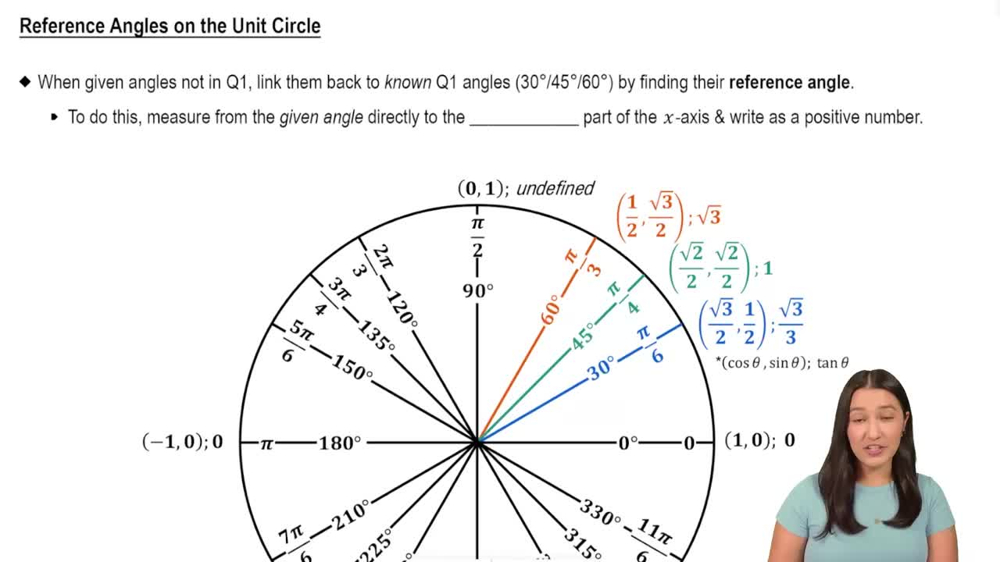
The reference angle is the acute angle formed by the terminal side of a given angle and the x-axis. It is always measured as a positive angle and is typically between 0 and π/2 radians (0° and 90°). For angles greater than 360° or 2π radians, the reference angle helps simplify trigonometric calculations by relating them to angles within the first quadrant.
Angles can be measured in degrees or radians, with radians being the standard unit in trigonometry. One full rotation (360°) is equivalent to 2π radians. Understanding how to convert between these two units is essential for finding reference angles, especially when dealing with angles expressed in radians, such as 11π/3.
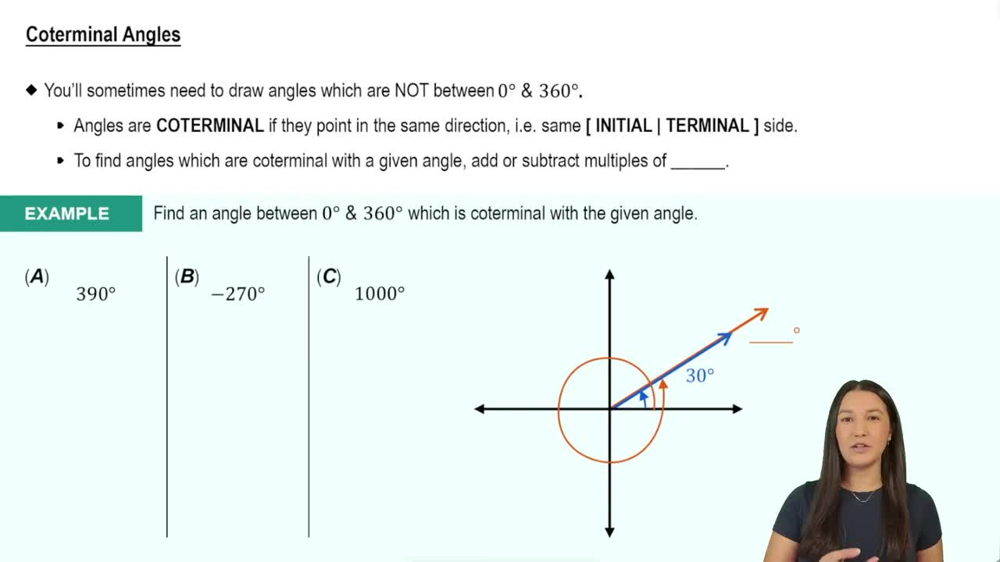
Coterminal angles are angles that share the same terminal side but differ by full rotations (multiples of 2π radians). To find a reference angle, it is often necessary to first determine a coterminal angle that lies within the standard range of 0 to 2π. This process involves subtracting or adding 2π until the angle falls within this range, making it easier to identify the reference angle.