Ch. 4 - Graphs of the Circular Functions
Lial - Trigonometry 12th Edition
Lial12th EditionTrigonometryISBN: 9780136552161Not the one you use?Change textbook
Chapter 5, Problem 19

Graph each function over a one-period interval.
y = cot (3x)

Verified step by step guidance
1
Identify the period of the function \(y = \cot(3x)\). Recall that the period of \(\cot(kx)\) is given by \(\frac{\pi}{k}\). Here, \(k = 3\), so the period is \(\frac{\pi}{3}\).
Choose a one-period interval to graph the function. Since the period is \(\frac{\pi}{3}\), a convenient interval is from \(0\) to \(\frac{\pi}{3}\).
Determine the key points within the interval where the function is undefined or crosses the x-axis. For \(\cot(3x)\), vertical asymptotes occur where \(\sin(3x) = 0\), i.e., at \(3x = n\pi\) for integers \(n\). Within \(0 \leq x \leq \frac{\pi}{3}\), this happens at \(x=0\) and \(x=\frac{\pi}{3}\).
Find the zeros of the function where \(\cot(3x) = 0\). This occurs when \(\tan(3x)\) is undefined, or equivalently when \(3x = \frac{\pi}{2} + n\pi\). Within the interval, this is at \(x = \frac{\pi}{6}\).
Plot the vertical asymptotes at \(x=0\) and \(x=\frac{\pi}{3}\), the zero at \(x=\frac{\pi}{6}\), and sketch the curve of \(y = \cot(3x)\) between these points, noting that \(\cot(3x)\) decreases from \(+\infty\) to \(-\infty\) over one period.

Verified video answer for a similar problem:

This video solution was recommended by our tutors as helpful for the problem above.
Was this helpful?

Key Concepts

Here are the essential concepts you must grasp in order to answer the question correctly.

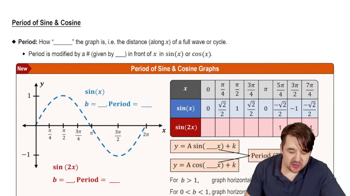
Period of Trigonometric Functions

The period of a trigonometric function is the length of the interval over which the function completes one full cycle. For cotangent, the basic period is π, but when the function is y = cot(kx), the period becomes π divided by the absolute value of k. Understanding this helps determine the interval over which to graph the function.
Recommended video:
5:33
Period of Sine and Cosine Functions

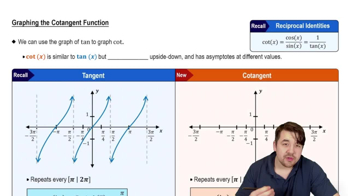
Cotangent Function Properties

The cotangent function, cot(x), is the reciprocal of the tangent function and has vertical asymptotes where sine is zero. It decreases from positive infinity to negative infinity within each period. Recognizing its shape and asymptotes is essential for accurate graphing.
Recommended video:
5:37
Introduction to Cotangent Graph

Effect of Horizontal Scaling on Graphs

Multiplying the variable x by a constant k inside a function, as in cot(3x), horizontally compresses or stretches the graph. Specifically, the graph compresses by a factor of 1/k, reducing the period and increasing the frequency of cycles within a given interval.
Recommended video:
5:10
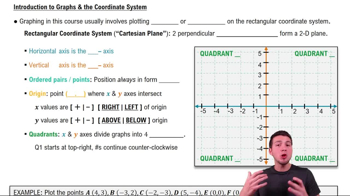
Introduction to Graphs & the Coordinate System