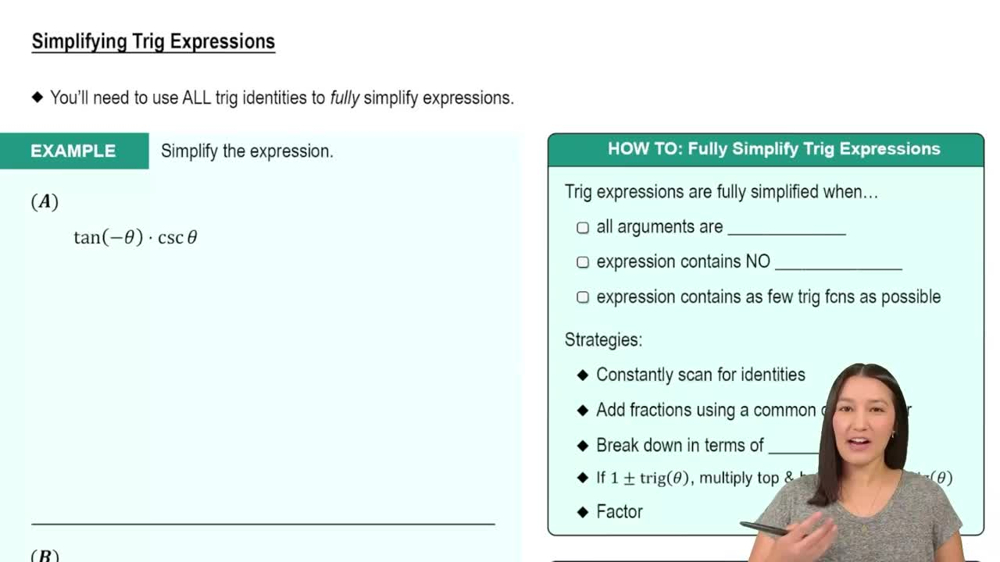
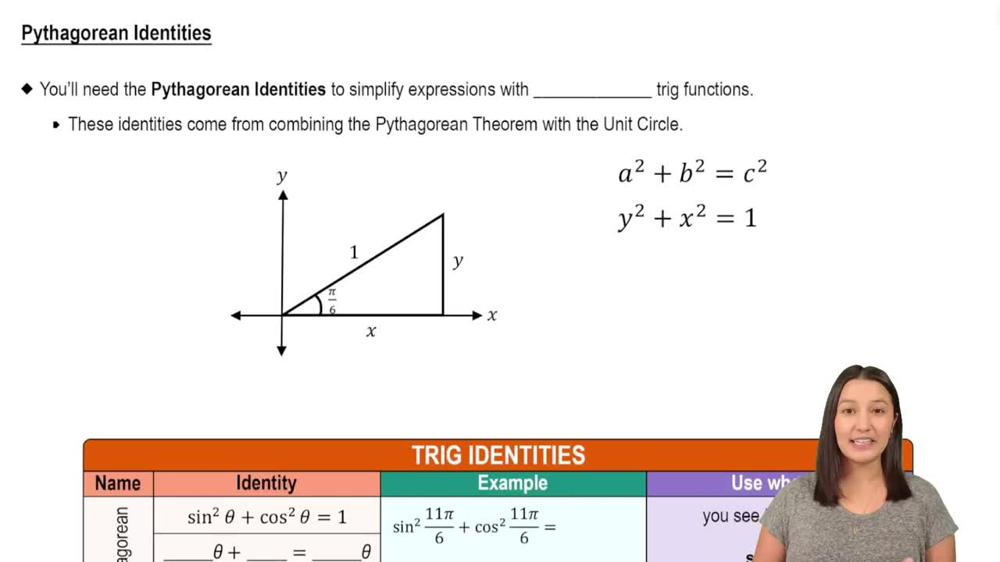
Recall the Pythagorean identity involving tangent and secant: \(\tan^{2} \theta + 1 = \sec^{2} \theta\).
Rewrite the expression \(\cos^{2} \theta (1 + \tan^{2} \theta)\) by substituting \(1 + \tan^{2} \theta\) with \(\sec^{2} \theta\), so it becomes \(\cos^{2} \theta \cdot \sec^{2} \theta\).
Express \(\sec \theta\) in terms of cosine: \(\sec \theta = \frac{1}{\cos \theta}\), so \(\sec^{2} \theta = \frac{1}{\cos^{2} \theta}\).
Substitute \(\sec^{2} \theta\) back into the expression to get \(\cos^{2} \theta \cdot \frac{1}{\cos^{2} \theta}\).
Simplify the expression by canceling \(\cos^{2} \theta\) in numerator and denominator, which results in \$1$, thus verifying the identity.
Verified video answer for a similar problem:
This video solution was recommended by our tutors as helpful for the problem above
Video duration:
2m
Play a video:
0 Comments
Key Concepts
Here are the essential concepts you must grasp in order to answer the question correctly.
Pythagorean Identity
The Pythagorean identity states that sin²θ + cos²θ = 1 for any angle θ. This fundamental relationship between sine and cosine is often used to simplify or verify trigonometric expressions involving squares of sine and cosine.
Tangent of an angle θ is defined as tan θ = sin θ / cos θ. Understanding this definition allows you to rewrite expressions involving tan²θ in terms of sine and cosine, facilitating simplification and verification of identities.
Algebraic Manipulation of Trigonometric Expressions
Verifying identities often requires algebraic skills such as factoring, expanding, and substituting equivalent expressions. Being able to manipulate trigonometric expressions correctly is essential to transform one side of the equation to match the other.

 2:39 minutes
 Verified step by step guidance
 6:25
6:25