Verify each identity. cos² θ (1 + tan² θ) = 1
Table of contents
- 0. Review of College Algebra4h 45m
- 1. Measuring Angles40m
- 2. Trigonometric Functions on Right Triangles2h 5m
- 3. Unit Circle1h 19m
- 4. Graphing Trigonometric Functions1h 19m
- 5. Inverse Trigonometric Functions and Basic Trigonometric Equations1h 41m
- 6. Trigonometric Identities and More Equations2h 34m
- 7. Non-Right Triangles1h 38m
- 8. Vectors2h 25m
- 9. Polar Equations2h 5m
- 10. Parametric Equations1h 6m
- 11. Graphing Complex Numbers1h 7m
6. Trigonometric Identities and More Equations
Introduction to Trigonometric Identities
Problem 69
Textbook Question
In Exercises 67–74, rewrite each expression in terms of the given function or functions. ;
Verified step by step guidance1
Start by rewriting the given expression clearly: \(\frac{\cos x}{1 + \sin x} + \tan x \cdot \cos x\).
Recall that \(\tan x = \frac{\sin x}{\cos x}\), so substitute \(\tan x\) in the expression to get \(\frac{\cos x}{1 + \sin x} + \frac{\sin x}{\cos x} \cdot \cos x\).
Simplify the second term by canceling \(\cos x\) in numerator and denominator: \(\frac{\cos x}{1 + \sin x} + \sin x\).
To combine the terms, express \(\sin x\) with a common denominator \(1 + \sin x\): write \(\sin x = \frac{\sin x (1 + \sin x)}{1 + \sin x}\).
Now add the two fractions: \(\frac{\cos x}{1 + \sin x} + \frac{\sin x (1 + \sin x)}{1 + \sin x} = \frac{\cos x + \sin x (1 + \sin x)}{1 + \sin x}\). This is the expression rewritten in terms of sine and cosine functions.
Verified video answer for a similar problem:This video solution was recommended by our tutors as helpful for the problem above
Video duration:
3mPlay a video:
0 Comments
Key Concepts
Here are the essential concepts you must grasp in order to answer the question correctly.
Trigonometric Identities
Trigonometric identities are equations involving trigonometric functions that hold true for all values within their domains. They allow rewriting expressions in different forms, such as converting between sine, cosine, and tangent. Common identities include Pythagorean identities and quotient identities, which are essential for simplifying or rewriting expressions.
Recommended video:
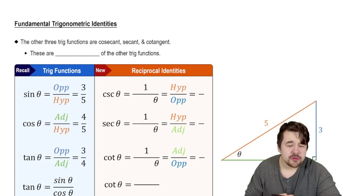
Fundamental Trigonometric Identities
Simplifying Complex Fractions
Simplifying complex fractions involves rewriting expressions with fractions in the numerator and denominator into simpler forms. This often requires finding common denominators, factoring, or multiplying numerator and denominator by conjugates. Mastery of this skill helps in expressing trigonometric expressions in terms of a single function or simpler combinations.
Recommended video:
Dividing Complex Numbers
Quotient and Reciprocal Relationships
The quotient identities relate tangent and cotangent to sine and cosine, such as tan x = sin x / cos x. Reciprocal identities express functions like sec x and csc x as reciprocals of cosine and sine, respectively. Understanding these relationships is crucial for rewriting expressions involving multiple trigonometric functions into a desired form.
Recommended video:
Quotients of Complex Numbers in Polar Form
Related Videos
Related Practice
Textbook Question
803
views