In Exercises 14–15, use the method of adding y-coordinates to graph each function for 0 ≤ x ≤ 2π.y = sin x + cos 1/2 x
Verified step by step guidance
1
Step 1: Understand the function y = \(\sin\) x + \(\cos\) \(\frac{1}{2}\)x. This function is a combination of two trigonometric functions: \(\sin\) x and \(\cos\) \(\frac{1}{2}\)x.
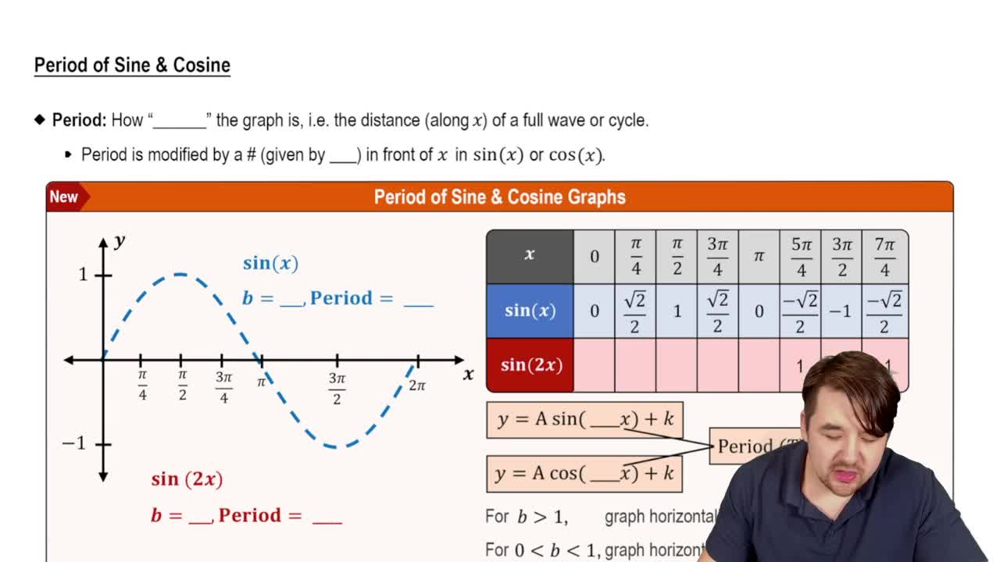
Step 2: Identify the period of each component. The period of \(\sin\) x is 2\(\pi\), and the period of \(\cos\) \(\frac{1}{2}\)x is 4\(\pi\) because the frequency is \(\frac{1}{2}\).
Step 3: Create a table of values for x ranging from 0 to 2\(\pi\). Calculate the corresponding y-values by adding the y-coordinates of \(\sin\) x and \(\cos\) \(\frac{1}{2}\)x for each x.
Step 4: Plot the points (x, y) on a graph using the calculated y-values from the table. This will help visualize the combined effect of the two functions over the interval 0 \(\leq\) x \(\leq\) 2\(\pi\).
Step 5: Connect the plotted points smoothly to form the graph of the function y = \(\sin\) x + \(\cos\) \(\frac{1}{2}\)x, observing the combined oscillations and periodic behavior.
Verified video answer for a similar problem:
This video solution was recommended by our tutors as helpful for the problem above
Video duration:
3m
Play a video:
0 Comments
Key Concepts
Here are the essential concepts you must grasp in order to answer the question correctly.
Trigonometric Functions
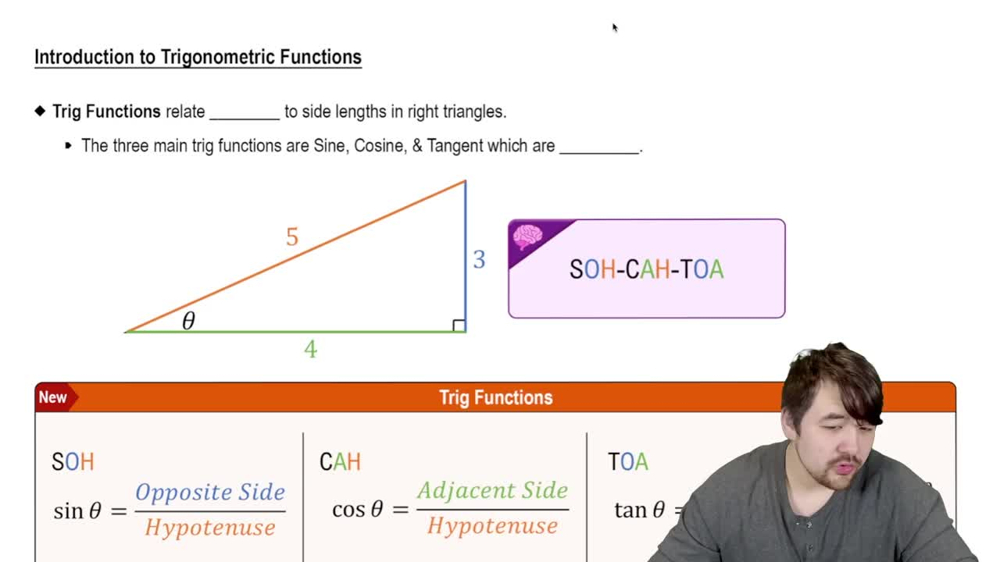
Trigonometric functions, such as sine and cosine, are fundamental periodic functions that describe relationships between angles and sides in right triangles. The sine function represents the ratio of the opposite side to the hypotenuse, while the cosine function represents the ratio of the adjacent side to the hypotenuse. Understanding their properties, including amplitude, period, and phase shift, is essential for graphing and analyzing their behavior.
Graphing techniques involve plotting points on a coordinate system to visualize mathematical functions. For trigonometric functions, this includes identifying key points such as maximum and minimum values, zeros, and periodicity. The method of adding y-coordinates, as mentioned in the question, requires calculating the values of the individual functions at specific x-values and then summing these values to find the corresponding y-coordinate for the graph.
Periodicity refers to the repeating nature of trigonometric functions over specific intervals. The sine and cosine functions have a fundamental period of 2π, meaning their values repeat every 2π units along the x-axis. When combining functions, such as sin x and cos(1/2 x), understanding their individual periods is crucial for accurately determining the overall behavior and shape of the resulting graph within the specified interval.