Ch. 2 - Graphs of the Trigonometric Functions; Inverse Trigonometric Functions
Blitzer - Trigonometry 3rd Edition
Blitzer3rd EditionTrigonometryISBN: 9780137316601Not the one you use?Change textbook
Chapter 2, Problem 38

In Exercises 37–40, an object moves in simple harmonic motion described by the given equation, where t is measured in seconds and d in inches. In each exercise, graph one period of the equation. Then find the following: a. the maximum displacement b. the frequency c. the time required for one cycle d. the phase shift of the motion. d = 3 cos(πt + π/2)

Verified step by step guidance
1
Identify the general form of the simple harmonic motion equation: \(d = A \cos(\omega t + \phi)\), where \(A\) is the amplitude (maximum displacement), \(\omega\) is the angular frequency, and \(\phi\) is the phase shift.
From the given equation \(d = 3 \cos(\pi t + \frac{\pi}{2})\), determine the amplitude \(A\) by looking at the coefficient of the cosine function. This gives the maximum displacement.
Find the angular frequency \(\omega\) by identifying the coefficient of \(t\) inside the cosine function, which is \(\pi\) in this case. Use the relationship between angular frequency and frequency: \(f = \frac{\omega}{2\pi}\) to find the frequency.
Calculate the time period \(T\) (time required for one cycle) using the formula \(T = \frac{1}{f}\) or equivalently \(T = \frac{2\pi}{\omega}\).
Determine the phase shift by analyzing the term \(\phi = \frac{\pi}{2}\) inside the cosine function. The phase shift in time units is given by \(-\frac{\phi}{\omega}\), which tells how much the graph is shifted horizontally.

Verified video answer for a similar problem:

This video solution was recommended by our tutors as helpful for the problem above.
Video duration:
5m
Was this helpful?

Key Concepts

Here are the essential concepts you must grasp in order to answer the question correctly.

Simple Harmonic Motion (SHM)

Simple Harmonic Motion describes oscillatory motion where the restoring force is proportional to displacement and acts in the opposite direction. The motion can be modeled by sinusoidal functions like sine or cosine, representing displacement over time. Understanding SHM helps interpret the given equation and its physical meaning.
Recommended video:
04:46
Products of Complex Numbers in Polar Form

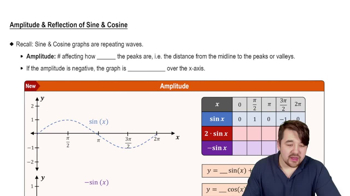
Amplitude, Frequency, and Period

Amplitude is the maximum displacement from the equilibrium position, frequency is the number of cycles per second, and period is the time for one complete cycle. In the equation d = 3 cos(πt + π/2), the amplitude is 3, frequency relates to the coefficient of t inside the cosine, and period is the reciprocal of frequency.
Recommended video:
5:05
Amplitude and Reflection of Sine and Cosine

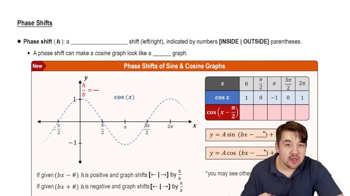
Phase Shift in Trigonometric Functions

Phase shift refers to the horizontal displacement of the wave from the standard position, caused by adding a constant inside the function's argument. In d = 3 cos(πt + π/2), the term π/2 shifts the graph left or right, affecting where the motion starts in time. Understanding phase shift is essential for accurately graphing and interpreting the motion.
Recommended video:
6:31
Phase Shifts