Apply the law of sines to the following: a = √5, c = 2√5, A = 30°. What is the value of sin C? What is the measure of C? Based on its angle measures, what kind of triangle is triangle ABC?
Table of contents
- 0. Review of College Algebra4h 45m
- 1. Measuring Angles40m
- 2. Trigonometric Functions on Right Triangles2h 5m
- 3. Unit Circle1h 19m
- 4. Graphing Trigonometric Functions1h 19m
- 5. Inverse Trigonometric Functions and Basic Trigonometric Equations1h 41m
- 6. Trigonometric Identities and More Equations2h 34m
- 7. Non-Right Triangles1h 38m
- 8. Vectors2h 25m
- 9. Polar Equations2h 5m
- 10. Parametric Equations1h 6m
- 11. Graphing Complex Numbers1h 7m
7. Non-Right Triangles
Law of Sines
Problem 13
Textbook Question
Find the unknown angles in triangle ABC for each triangle that exists.
A = 29.7°, b = 41.5 ft, a = 27.2 ft
Verified step by step guidance1
Identify the given elements: angle \(A = 29.7^\circ\), side \(a = 27.2\) ft (opposite angle \(A\)), and side \(b = 41.5\) ft (opposite angle \(B\)). We need to find the unknown angles \(B\) and \(C\) in triangle \(ABC\).
Use the Law of Sines to find angle \(B\). The Law of Sines states: \(\frac{a}{\sin A} = \frac{b}{\sin B}\). Rearranged to solve for \(\sin B\), it becomes \(\sin B = \frac{b \cdot \sin A}{a}\).
Calculate \(\sin B\) using the known values, then find angle \(B\) by taking the inverse sine (arcsin) of that value. Remember that the sine function can have two possible angles between \(0^\circ\) and \(180^\circ\), so consider both possible values for \(B\) if applicable.
For each possible value of angle \(B\), find angle \(C\) using the fact that the sum of angles in a triangle is \(180^\circ\). So, \(C = 180^\circ - A - B\).
Check the validity of each triangle by ensuring all angles are positive and the sides satisfy the triangle inequality. This will confirm how many triangles exist with the given data.
Verified video answer for a similar problem:This video solution was recommended by our tutors as helpful for the problem above
Play a video:
0 Comments
Key Concepts
Here are the essential concepts you must grasp in order to answer the question correctly.
Law of Sines
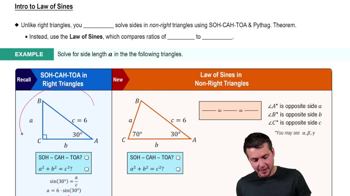
The Law of Sines relates the ratios of the lengths of sides of a triangle to the sines of their opposite angles. It is expressed as (a/sin A) = (b/sin B) = (c/sin C). This law is essential for finding unknown angles or sides when given two sides and an angle not included between them.
Recommended video:
Intro to Law of Sines
Ambiguous Case of the Law of Sines (SSA Condition)
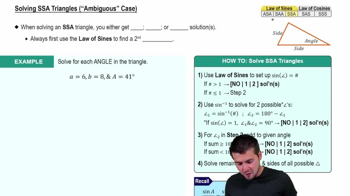
When two sides and a non-included angle (SSA) are known, there can be zero, one, or two possible triangles. This ambiguity arises because the given data may correspond to different configurations, so checking for the number of valid solutions is crucial.
Recommended video:
Solving SSA Triangles ("Ambiguous" Case)
Triangle Angle Sum Property
The sum of the interior angles in any triangle is always 180°. After finding one unknown angle using the Law of Sines, this property helps determine the remaining angle by subtracting the known angles from 180°.
Recommended video:
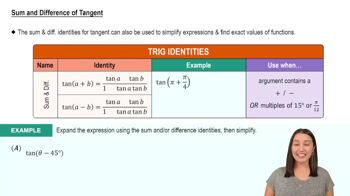
Sum and Difference of Tangent
Related Videos
Related Practice
Textbook Question
609
views