Find the unknown angles in triangle ABC for each triangle that exists.
C = 41° 20', b = 25.9 m, c = 38.4 m
Verified step by step guidance
1
Identify the given elements of triangle ABC: angle \( C = 41^\circ 20' \), side \( b = 25.9 \) m, and side \( c = 38.4 \) m. We need to find the unknown angles \( A \) and \( B \).
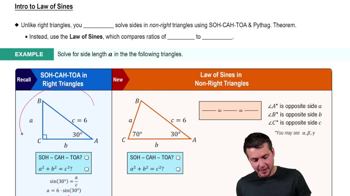
Use the Law of Sines, which states that \( \frac{a}{\sin A} = \frac{b}{\sin B} = \frac{c}{\sin C} \). Since we know \( b \), \( c \), and \( C \), we can find angle \( B \) by setting up the ratio \( \frac{b}{\sin B} = \frac{c}{\sin C} \).
Rearrange the equation to solve for \( \sin B \): \(\n\[\n\]\sin B = \frac{b \cdot \sin C}{c}\[\n\]\nCalculate\) \( \sin C \) by converting \( 41^\circ 20' \) to decimal degrees first (i.e., \( 41 + \frac{20}{60} \)) and then find \( \sin C \).
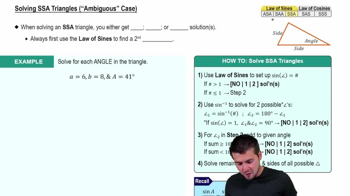
Determine angle \( B \) by taking the inverse sine (arcsin) of the value found for \( \sin B \). Note that there may be two possible angles for \( B \) because sine is positive in both the first and second quadrants, so consider both \( B \) and \( 180^\circ - B \) if they satisfy the triangle inequality.
Find angle \( A \) using the fact that the sum of angles in a triangle is \( 180^\circ \): \(\n\[\n\]A = 180^\circ - B - C\[\n\]\nCheck\) for the existence of one or two triangles based on the possible values of \( B \) and ensure all angles are positive and less than \( 180^\circ \).
Verified video answer for a similar problem:
This video solution was recommended by our tutors as helpful for the problem above
Play a video:
0 Comments
Key Concepts
Here are the essential concepts you must grasp in order to answer the question correctly.
Law of Cosines
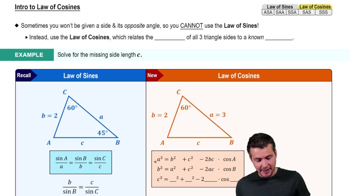
The Law of Cosines relates the lengths of sides of a triangle to the cosine of one of its angles. It is useful for finding an unknown angle when two sides and the included angle or three sides are known. The formula is c² = a² + b² - 2ab cos(C), allowing calculation of angles from side lengths.
The Law of Sines states that the ratio of the length of a side to the sine of its opposite angle is constant in any triangle: a/sin(A) = b/sin(B) = c/sin(C). It is particularly helpful for finding unknown angles or sides when given an angle-side pair and another side or angle, and for identifying ambiguous cases.
Ambiguous Case of the Law of Sines (SSA Condition)
When two sides and a non-included angle (SSA) are known, there may be zero, one, or two possible triangles. This ambiguity arises because the given data can correspond to different configurations. Understanding this helps determine all possible solutions for the unknown angles in the problem.