Identify the given elements of the triangle: angle \(B = 72.2^\circ\), side \(b = 78.3\) m (opposite angle \(B\)), and side \(c = 145\) m (opposite angle \(C\)). We need to find the remaining parts of the triangle: angles \(A\) and \(C\), and side \(a\).
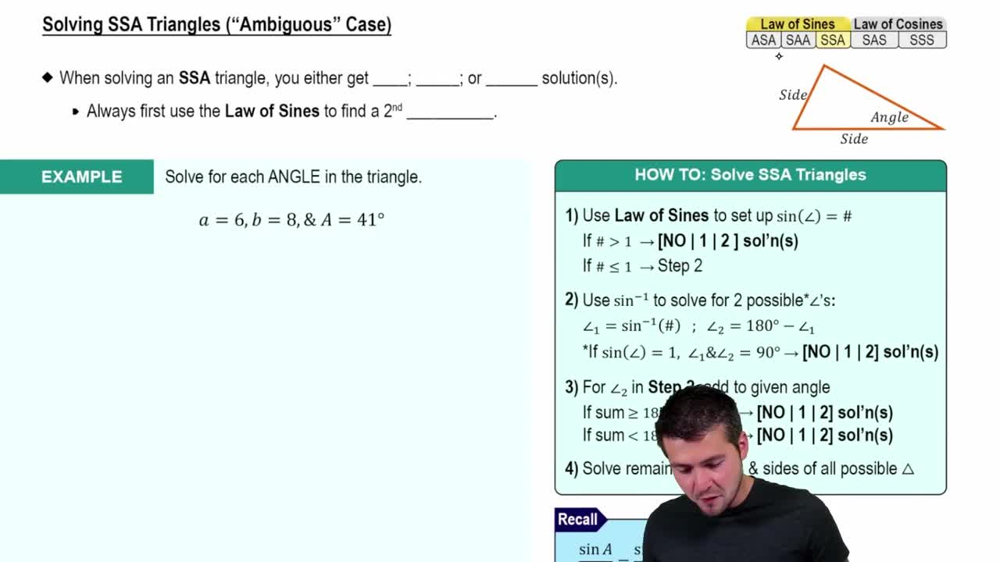
Use the Law of Sines to find angle \(C\). The Law of Sines states: \(\frac{a}{\sin A} = \frac{b}{\sin B} = \frac{c}{\sin C}\). From this, we can write \(\sin C = \frac{c \sin B}{b}\).
Calculate \(\sin C\) using the values of \(b\), \(c\), and \(\sin B\). Then find angle \(C\) by taking the inverse sine (arcsin) of \(\sin C\). Remember to consider the possibility of two solutions for angle \(C\) (the ambiguous case) because sine is positive in two quadrants.
Once angle \(C\) is found, calculate angle \(A\) using the fact that the sum of angles in a triangle is \(180^\circ\): \(A = 180^\circ - B - C\).
Finally, use the Law of Sines again to find side \(a\): \(a = \frac{b \sin A}{\sin B}\). This completes the solution of the triangle.
Verified video answer for a similar problem:
This video solution was recommended by our tutors as helpful for the problem above
Play a video:
0 Comments
Key Concepts
Here are the essential concepts you must grasp in order to answer the question correctly.
Law of Sines
The Law of Sines relates the sides and angles of a triangle through the ratio sin(A)/a = sin(B)/b = sin(C)/c. It is essential for solving triangles when given two sides and an angle not included between them, allowing calculation of unknown angles or sides.
The sum of the interior angles in any triangle is always 180°. This property helps find the third angle once two angles are known, which is crucial for completing the solution of the triangle.
Ambiguous Case of the Law of Sines (SSA Condition)
When two sides and a non-included angle are given (SSA), there can be zero, one, or two possible triangles. Understanding this ambiguity is important to determine all possible solutions or to conclude if no triangle exists.

 Verified step by step guidance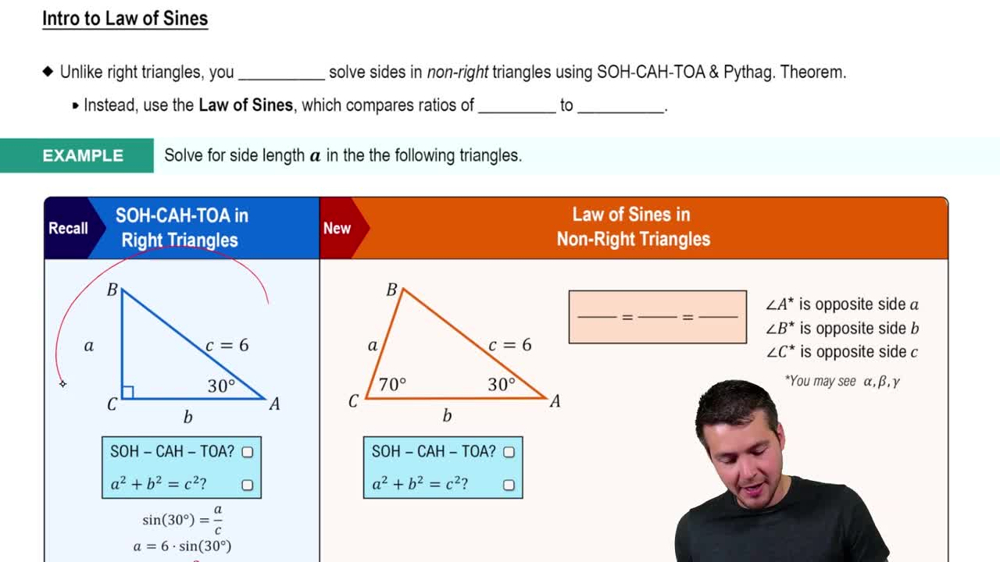
 4:27
4:27