Join thousands of students who trust us to help them ace their exams!
Multiple Choice
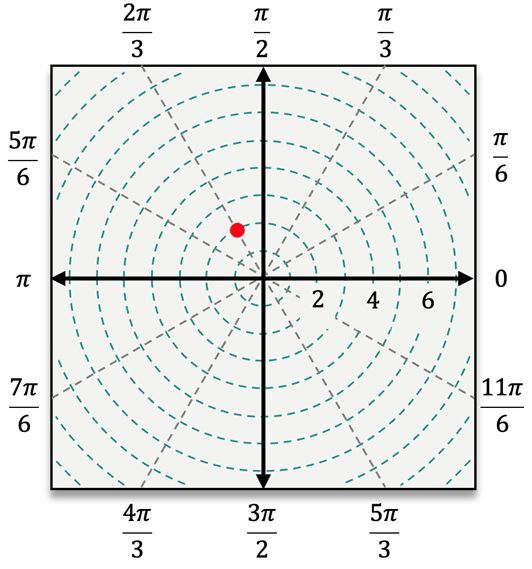
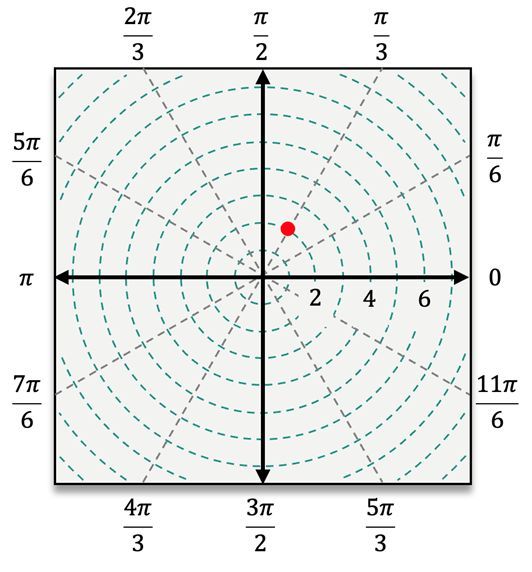
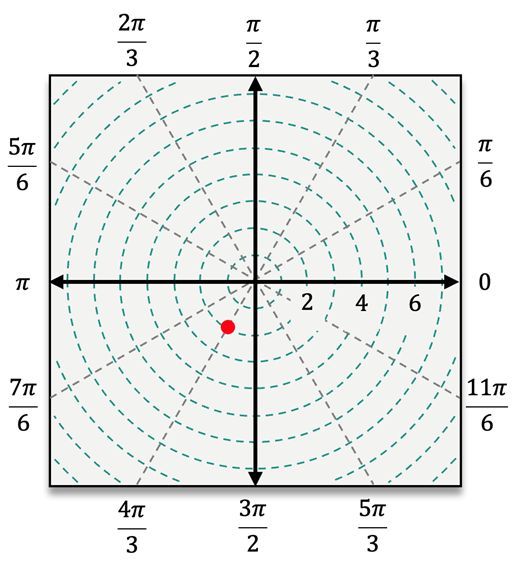
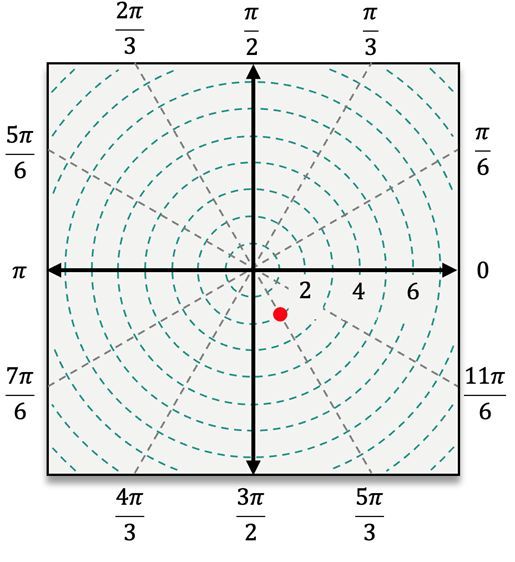
Plot the point on the polar coordinate system. (−2,32π)
A
B
C
D
0 Comments
Verified step by step guidance
1
Understand that polar coordinates are given in the form (r, θ), where r is the radius (distance from the origin) and θ is the angle from the positive x-axis.
The given polar coordinate is (-2, \(\frac{2\pi}{3}\)). The negative radius indicates that the point is in the opposite direction of the angle.
First, locate the angle \(\frac{2\pi}{3}\) on the polar coordinate system. This angle is in the second quadrant, 120 degrees from the positive x-axis.
Since the radius is negative, move 2 units in the opposite direction of the angle \(\frac{2\pi}{3}\). This means you will move 2 units in the direction of the angle \(\frac{5\pi}{3}\) (or 300 degrees), which is directly opposite to \(\frac{2\pi}{3}\).
Plot the point at this location, which should be in the fourth quadrant, 2 units from the origin along the line of \(\frac{5\pi}{3}\).




 Verified step by step guidance

