Join thousands of students who trust us to help them ace their exams!
Multiple Choice
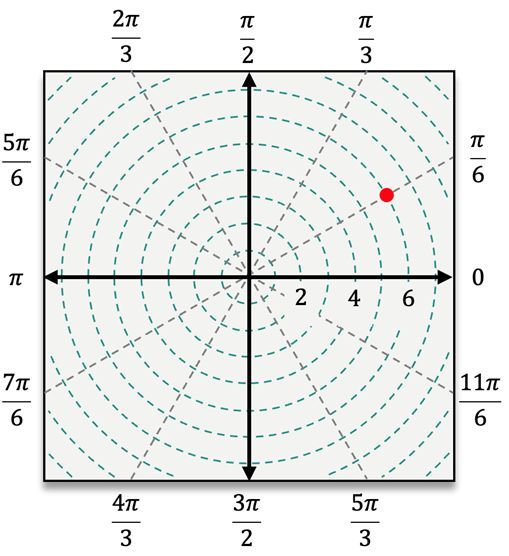
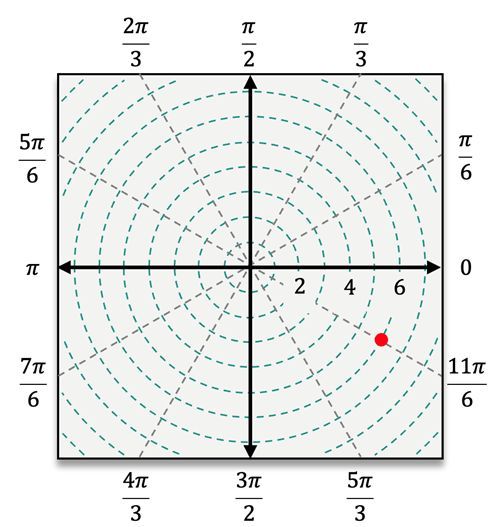
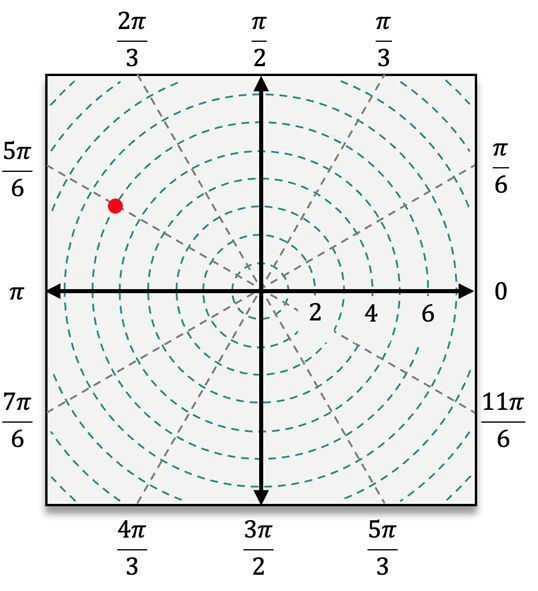
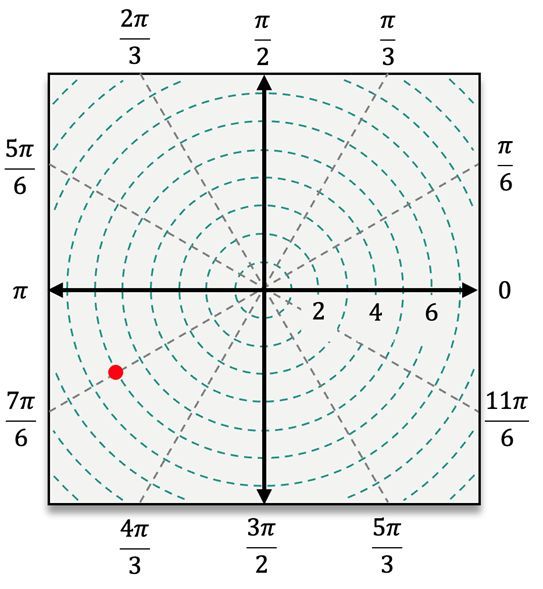
Plot the point on the polar coordinate system. (6,−611π)
A
B
C
D
0 Comments
Verified step by step guidance
1
Identify the polar coordinates given: (6, -\(\frac{11\pi}{6}\)). The first value, 6, is the radius (r), and the second value, -\(\frac{11\pi}{6}\), is the angle (\(\theta\)) in radians.
Convert the negative angle to a positive angle by adding 2\(\pi\). Since -\(\frac{11\pi}{6}\) is negative, add 2\(\pi\) to find the equivalent positive angle: -\(\frac{11\pi}{6}\) + 2\(\pi\) = \(\frac{\pi}{6}\).
Locate the angle \(\frac{\pi}{6}\) on the polar coordinate system. This angle is in the first quadrant, 30 degrees from the positive x-axis.
From the origin, move along the direction of the angle \(\frac{\pi}{6}\) to a distance of 6 units, as indicated by the radius.
Plot the point at the intersection of the line at angle \(\frac{\pi}{6}\) and the circle with radius 6. This is the correct location of the point (6, -\(\frac{11\pi}{6}\)) on the polar coordinate system.




 Verified step by step guidance

