Ch. 1 - Angles and the Trigonometric Functions
Blitzer - Trigonometry 3rd Edition
Blitzer3rd EditionTrigonometryISBN: 9780137316601Not the one you use?Change textbook
Chapter 1, Problem 1.24a

Use the unit circle shown to find the value of the trigonometric function.
tan 11πœ‹/6

Verified step by step guidance
1
Step 1: Understand that the unit circle is a circle with a radius of 1 centered at the origin of a coordinate plane. The angle 11πœ‹/6 is measured in radians.
Step 2: Convert the angle 11πœ‹/6 to a more familiar angle by subtracting 2πœ‹ (a full circle) from it, since 11πœ‹/6 is greater than 2πœ‹. This will help find the equivalent angle within the first circle rotation.
Step 3: Calculate 11πœ‹/6 - 2πœ‹. Since 2πœ‹ is equivalent to 12πœ‹/6, subtracting gives 11πœ‹/6 - 12πœ‹/6 = -πœ‹/6. This means 11πœ‹/6 is coterminal with -πœ‹/6.
Step 4: Recognize that -πœ‹/6 is equivalent to 11πœ‹/6 on the unit circle, and it corresponds to the reference angle πœ‹/6 in the fourth quadrant.
Step 5: Use the fact that in the fourth quadrant, the tangent function is negative. The reference angle πœ‹/6 has a tangent value of 1/√3, so tan(11πœ‹/6) = -1/√3.

Verified video answer for a similar problem:

This video solution was recommended by our tutors as helpful for the problem above.
Video duration:
2m
Was this helpful?

Key Concepts

Here are the essential concepts you must grasp in order to answer the question correctly.

Unit Circle

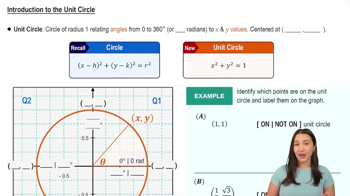
The unit circle is a circle with a radius of one centered at the origin of a coordinate plane. It is a fundamental tool in trigonometry, as it allows for the definition of trigonometric functions based on angles measured from the positive x-axis. Each point on the unit circle corresponds to a specific angle and its sine and cosine values, which are essential for calculating other trigonometric functions.
Recommended video:
06:11
Introduction to the Unit Circle

Tangent Function

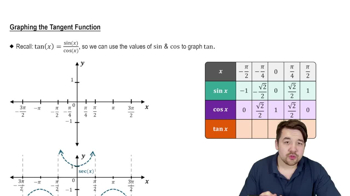
The tangent function, denoted as tan(ΞΈ), is defined as the ratio of the sine and cosine of an angle: tan(ΞΈ) = sin(ΞΈ) / cos(ΞΈ). It represents the slope of the line formed by the angle in the unit circle. Understanding how to derive the tangent from the unit circle is crucial for solving problems involving angles and their corresponding trigonometric values.
Recommended video:
5:43
Introduction to Tangent Graph

Angle Measurement in Radians

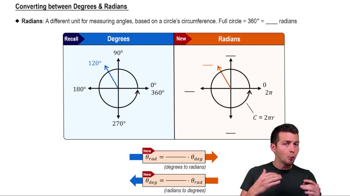
In trigonometry, angles can be measured in degrees or radians, with radians being the standard unit in mathematical contexts. The angle 11Ο€/6 radians corresponds to 330 degrees, which is important for locating the angle on the unit circle. Recognizing how to convert between radians and degrees is essential for accurately determining the values of trigonometric functions.
Recommended video:
5:04
Converting between Degrees & Radians