In Exercises 69–76, find all the complex roots. Write roots in rectangular form. If necessary, round to the nearest tenth.The complex fifth roots of 32 (cos 5π/3 + i sin 5π/3)
Verified step by step guidance
1
Step 1: Express the given complex number in polar form. The given complex number is 32 (\(\cos\) \(\frac{5\pi}{3}\) + i \(\sin\) \(\frac{5\pi}{3}\)). This is already in polar form with modulus 32 and argument \(\frac{5\pi}{3}\).
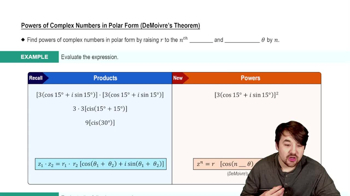
Step 2: Use De Moivre's Theorem to find the fifth roots. According to De Moivre's Theorem, the nth roots of a complex number with modulus r and argument \(\theta\) are given by: r^{1/n} \(\left\)( \(\cos\) \(\frac{\theta + 2k\pi}{n}\) + i \(\sin\) \(\frac{\theta + 2k\pi}{n}\) \(\right\)), where k = 0, 1, 2, ..., n-1.
Step 3: Calculate the modulus of the fifth roots. The modulus of each root is 32^{1/5}.
Step 4: Calculate the arguments for each of the five roots. The arguments are \(\frac{5\pi}{15}\) + \(\frac{2k\pi}{5}\) for k = 0, 1, 2, 3, 4.
Step 5: Write each root in rectangular form. Convert each polar form root to rectangular form using the formula: r (\(\cos\) \(\theta\) + i \(\sin\) \(\theta\)) = r \(\cos\) \(\theta\) + i r \(\sin\) \(\theta\).
Verified video answer for a similar problem:
This video solution was recommended by our tutors as helpful for the problem above
Play a video:
0 Comments
Key Concepts
Here are the essential concepts you must grasp in order to answer the question correctly.
Complex Numbers
Complex numbers are numbers that have a real part and an imaginary part, expressed in the form a + bi, where 'a' is the real part and 'b' is the coefficient of the imaginary unit 'i'. Understanding complex numbers is essential for solving problems involving roots, especially in trigonometric contexts where angles and magnitudes are involved.
De Moivre's Theorem states that for any complex number in polar form r(cos θ + i sin θ), the nth roots can be found using the formula r^(1/n)(cos(θ/n + 2kπ/n) + i sin(θ/n + 2kπ/n)), where k is an integer from 0 to n-1. This theorem is crucial for finding complex roots, as it simplifies the process of extracting roots from complex numbers.
Powers Of Complex Numbers In Polar Form (DeMoivre's Theorem)
Rectangular Form
Rectangular form refers to the standard way of expressing complex numbers as a + bi. When finding complex roots, it is often necessary to convert from polar form (which uses magnitude and angle) to rectangular form for clarity and ease of interpretation. This conversion involves calculating the real and imaginary components based on the cosine and sine of the angle.