In Exercises 69–76, find all the complex roots. Write roots in rectangular form. If necessary, round to the nearest tenth.The complex sixth roots of 64
Verified step by step guidance
1
Identify the problem as finding the sixth roots of a complex number, which is 64 in this case.
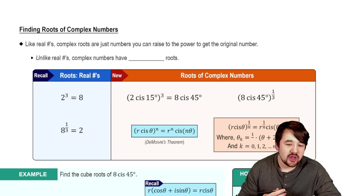
Express 64 in polar form. Since 64 is a real number, it can be written as \(64 = 64 \text{cis} 0^\circ\), where \(\text{cis} \theta = \cos \theta + i \sin \theta\).
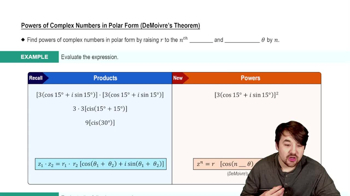
Use De Moivre's Theorem to find the sixth roots. According to the theorem, the \(n\)th roots of a complex number \(r \text{cis} \theta\) are given by \(r^{1/n} \text{cis} \left(\frac{\theta + 360k}{n}\right)\) for \(k = 0, 1, 2, \ldots, n-1\).
Calculate \(r^{1/6}\), which is \$64^{1/6}\(. Since \)64 = 2^6\(, \)64^{1/6} = 2$.
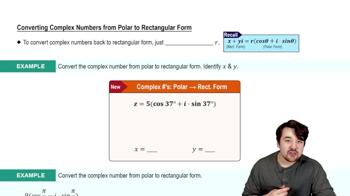
Find the angles for each root by substituting \(k = 0, 1, 2, 3, 4, 5\) into the formula \(\frac{0 + 360k}{6}\), and express each root in rectangular form using \(2 \text{cis} \theta = 2(\cos \theta + i \sin \theta)\).
Verified video answer for a similar problem:
This video solution was recommended by our tutors as helpful for the problem above
Play a video:
0 Comments
Key Concepts
Here are the essential concepts you must grasp in order to answer the question correctly.
Complex Numbers
Complex numbers are numbers that have a real part and an imaginary part, expressed in the form a + bi, where a and b are real numbers, and i is the imaginary unit defined as the square root of -1. Understanding complex numbers is essential for solving problems involving roots, especially when dealing with non-real solutions.
Finding the roots of complex numbers involves determining the values that, when raised to a certain power, yield the original complex number. For sixth roots, we apply De Moivre's Theorem, which states that the nth roots of a complex number can be found by converting the number to polar form and then dividing the angle by n while adjusting for the periodic nature of trigonometric functions.
Rectangular form refers to expressing complex numbers in the standard a + bi format. When finding roots, it is often necessary to convert from polar form (r(cos θ + i sin θ)) back to rectangular form to provide a clear and usable representation of the roots, especially when rounding to specific decimal places.