Use the figure to find each vector: u - v. Use vector notation as in Example 4.
Table of contents
- 0. Review of College Algebra4h 45m
- 1. Measuring Angles40m
- 2. Trigonometric Functions on Right Triangles2h 5m
- 3. Unit Circle1h 19m
- 4. Graphing Trigonometric Functions1h 19m
- 5. Inverse Trigonometric Functions and Basic Trigonometric Equations1h 41m
- 6. Trigonometric Identities and More Equations2h 34m
- 7. Non-Right Triangles1h 38m
- 8. Vectors2h 25m
- 9. Polar Equations2h 5m
- 10. Parametric Equations1h 6m
- 11. Graphing Complex Numbers1h 7m
8. Vectors
Geometric Vectors
Problem 16
Textbook Question
Vector v has the given direction angle and magnitude. Find the horizontal and vertical components.
θ = 50°, |v| = 26
Verified step by step guidance1
Identify the given information: the direction angle \( \theta = 50^\circ \) and the magnitude of the vector \( |v| = 26 \).
Recall that the horizontal component (\( v_x \)) of a vector can be found using the formula \( v_x = |v| \cdot \cos(\theta) \).
Recall that the vertical component (\( v_y \)) of a vector can be found using the formula \( v_y = |v| \cdot \sin(\theta) \).
Substitute the given values into the formulas: \( v_x = 26 \cdot \cos(50^\circ) \) and \( v_y = 26 \cdot \sin(50^\circ) \).
Calculate the cosine and sine of \( 50^\circ \) using a calculator or trigonometric tables, then multiply by 26 to find the components.
Verified video answer for a similar problem:This video solution was recommended by our tutors as helpful for the problem above
Play a video:
0 Comments
Key Concepts
Here are the essential concepts you must grasp in order to answer the question correctly.
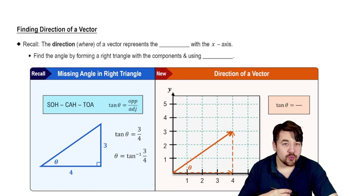
Direction Angle of a Vector
The direction angle θ of a vector is the angle it makes with the positive x-axis, measured counterclockwise. It determines the vector's orientation in the plane and is essential for decomposing the vector into components along the horizontal and vertical axes.
Recommended video:
Finding Direction of a Vector
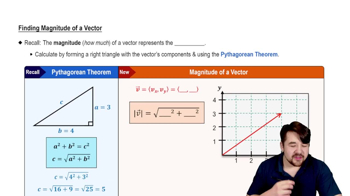
Magnitude of a Vector
The magnitude |v| of a vector represents its length or size. It is a scalar quantity that, combined with the direction angle, fully describes the vector. Knowing the magnitude allows calculation of the vector's components using trigonometric functions.
Recommended video:
Finding Magnitude of a Vector
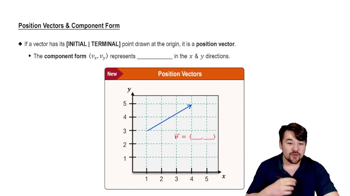
Resolving a Vector into Components
A vector can be broken down into horizontal (x) and vertical (y) components using trigonometry: x = |v| cos(θ) and y = |v| sin(θ). This process simplifies vector analysis by expressing it in terms of perpendicular directions.
Recommended video:
Position Vectors & Component Form
Related Videos
Related Practice
Textbook Question
662
views