In Exercises 9–16, evaluate the trigonometric function at the quadrantal angle, or state that the expression is undefined.cos 3𝜋2
Verified step by step guidance
1
Identify the angle given in the problem: \( \frac{3\pi}{2} \).
Recognize that \( \frac{3\pi}{2} \) is a quadrantal angle, which means it lies on one of the axes of the unit circle.
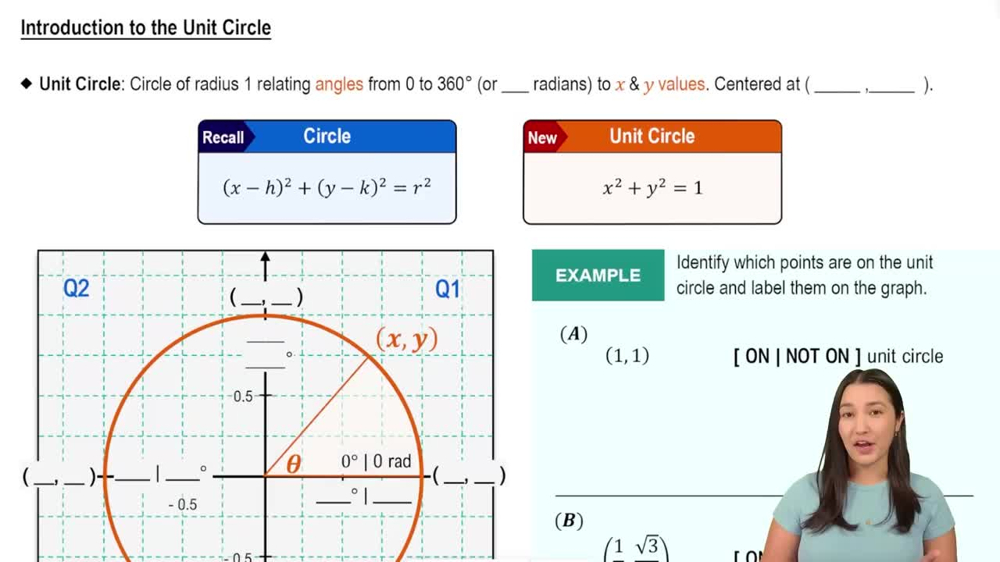
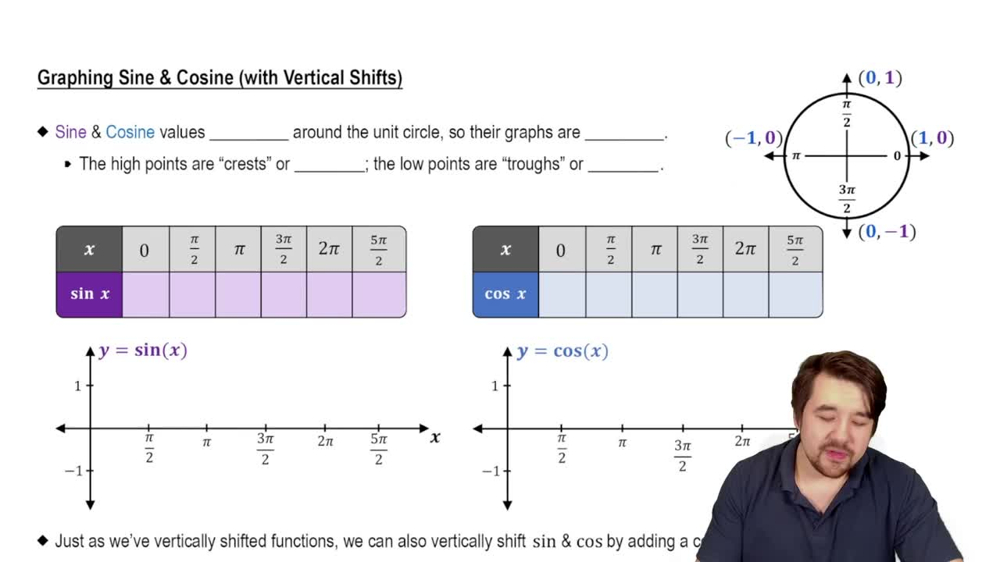
Recall the unit circle coordinates for quadrantal angles: \( 0 \), \( \frac{\pi}{2} \), \( \pi \), \( \frac{3\pi}{2} \), and \( 2\pi \).
Determine the coordinates of the point on the unit circle at \( \frac{3\pi}{2} \), which is \((0, -1)\).
Use the fact that the cosine of an angle is the x-coordinate of the corresponding point on the unit circle to find \( \cos \frac{3\pi}{2} \).
Verified video answer for a similar problem:
This video solution was recommended by our tutors as helpful for the problem above
Video duration:
1m
Play a video:
0 Comments
Key Concepts
Here are the essential concepts you must grasp in order to answer the question correctly.
Quadrantal Angles
Quadrantal angles are angles that are multiples of 90 degrees (or π/2 radians) and correspond to the axes on the unit circle. These angles include 0, π/2, π, 3π/2, and 2π. At these angles, the sine and cosine functions take on specific values, which are essential for evaluating trigonometric functions.
The unit circle is a circle with a radius of one centered at the origin of a coordinate plane. It is a fundamental tool in trigonometry, as it allows us to define the sine and cosine of angles based on the coordinates of points on the circle. For quadrantal angles, the coordinates directly provide the values of the trigonometric functions.
The cosine function, denoted as cos(θ), represents the x-coordinate of a point on the unit circle corresponding to an angle θ. For quadrantal angles, the cosine values are straightforward: cos(0) = 1, cos(π/2) = 0, cos(π) = -1, and cos(3π/2) = 0. Understanding these values is crucial for evaluating expressions involving cosine at specific angles.