In Exercises 9–16, evaluate the trigonometric function at the quadrantal angle, or state that the expression is undefined.csc 𝜋
Verified step by step guidance
1
Identify the trigonometric function: The problem asks for the evaluation of the cosecant function, \( \csc \theta \), at the angle \( \pi \).
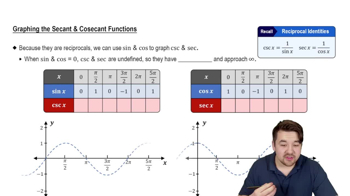
Recall the definition of cosecant: \( \csc \theta = \frac{1}{\sin \theta} \).
Determine the sine of the angle: Since \( \pi \) radians corresponds to 180 degrees, which is a quadrantal angle, find \( \sin \pi \).
Evaluate \( \sin \pi \): The sine of \( \pi \) radians (or 180 degrees) is 0.
Check for undefined expression: Since \( \csc \theta = \frac{1}{\sin \theta} \), and \( \sin \pi = 0 \), the expression \( \csc \pi \) is undefined because division by zero is not possible.
Verified video answer for a similar problem:
This video solution was recommended by our tutors as helpful for the problem above
Video duration:
2m
Play a video:
0 Comments
Key Concepts
Here are the essential concepts you must grasp in order to answer the question correctly.
Quadrantal Angles
Quadrantal angles are angles that are multiples of 90 degrees (or π/2 radians), which correspond to the axes in the unit circle. These angles include 0, π/2, π, 3π/2, and 2π. At these angles, the sine and cosine functions take on specific values, which are essential for evaluating trigonometric functions like cosecant.
The cosecant function, denoted as csc, is the reciprocal of the sine function. It is defined as csc(θ) = 1/sin(θ). Therefore, to evaluate csc at a specific angle, one must first determine the sine of that angle. If the sine is zero, the cosecant is undefined, as division by zero is not possible.
Evaluating trigonometric functions involves determining the value of the function at a given angle. For quadrantal angles, this often requires knowledge of the unit circle and the specific sine and cosine values at those angles. Understanding how to find these values is crucial for solving problems involving trigonometric functions.