Ch. 4 - Laws of Sines and Cosines; Vectors
Blitzer - Trigonometry 3rd Edition
Blitzer3rd EditionTrigonometryISBN: 9780137316601Not the one you use?Change textbook
Chapter 4, Problem 6

In Exercises 1–8, solve each triangle. Round lengths of sides to the nearest tenth and angle measures to the nearest degree.

Verified step by step guidance
1
Identify the type of triangle problem you are dealing with: whether you have two sides and an included angle (SAS), two angles and a side (ASA or AAS), or three sides (SSS). This will determine which trigonometric laws or formulas to use.
If you have two sides and the included angle (SAS), use the Law of Cosines to find the third side: \[ c^2 = a^2 + b^2 - 2ab \cos(C) \] where \(a\) and \(b\) are known sides and \(C\) is the included angle.
Once you have all three sides, or if you started with three sides (SSS), use the Law of Cosines or Law of Sines to find the unknown angles. For example, to find angle \(A\) using Law of Cosines: \[ \cos(A) = \frac{b^2 + c^2 - a^2}{2bc} \]
If you have two angles and one side (ASA or AAS), first find the third angle by subtracting the sum of the known angles from 180°: \[ C = 180^\circ - A - B \] Then use the Law of Sines to find the unknown sides: \[ \frac{a}{\sin(A)} = \frac{b}{\sin(B)} = \frac{c}{\sin(C)} \]
After calculating all sides and angles, round the side lengths to the nearest tenth and the angle measures to the nearest degree as required.

Verified video answer for a similar problem:

This video solution was recommended by our tutors as helpful for the problem above.
Video duration:
4m
Was this helpful?

Key Concepts

Here are the essential concepts you must grasp in order to answer the question correctly.

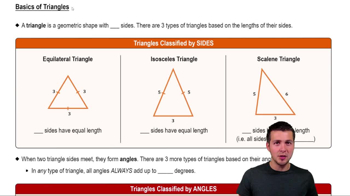
Types of Triangles and Their Properties

Understanding whether a triangle is right, acute, or obtuse is essential because it determines which trigonometric rules apply. Recognizing side lengths and angle measures helps in choosing the correct method to solve the triangle.
Recommended video:
4:42
Review of Triangles

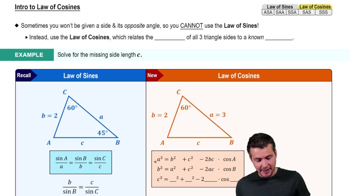
Law of Sines and Law of Cosines

These laws are fundamental for solving triangles when not all sides and angles are known. The Law of Sines relates ratios of sides to the sines of opposite angles, while the Law of Cosines generalizes the Pythagorean theorem for any triangle.
Recommended video:
4:35
Intro to Law of Cosines

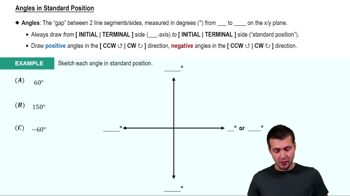
Rounding and Angle Measurement Conventions

Accurate rounding of side lengths to the nearest tenth and angles to the nearest degree ensures clarity and precision in answers. Understanding degree measurement and rounding rules is crucial for presenting final solutions correctly.
Recommended video:
05:50
Drawing Angles in Standard Position