For each function, find (a) ƒ(2) and (b) ƒ(-1). See Example 7. ƒ = {(2, 5), (3, 9), (-1, 11), (5, 3)}
Table of contents
- 0. Review of College Algebra4h 45m
- 1. Measuring Angles40m
- 2. Trigonometric Functions on Right Triangles2h 5m
- 3. Unit Circle1h 19m
- 4. Graphing Trigonometric Functions1h 19m
- 5. Inverse Trigonometric Functions and Basic Trigonometric Equations1h 41m
- 6. Trigonometric Identities and More Equations2h 34m
- 7. Non-Right Triangles1h 38m
- 8. Vectors2h 25m
- 9. Polar Equations2h 5m
- 10. Parametric Equations1h 6m
- 11. Graphing Complex Numbers1h 7m
0. Review of College Algebra
Functions
Problem 71a
Textbook Question
Determine the largest open intervals of the domain over which each function is (a) increasing See Example 8.
Verified step by step guidance1
Identify the given function for which you need to determine the intervals of increase. The problem refers to 'each function,' so start by clearly writing down the function(s) involved.
Recall that a function is increasing on intervals where its first derivative is positive. Therefore, find the first derivative of the function, denoted as \(f'(x)\).
Set up the inequality \(f'(x) > 0\) to find where the function is increasing. Solve this inequality to determine the values of \(x\) for which the derivative is positive.
Analyze the critical points where \(f'(x) = 0\) or where \(f'(x)\) is undefined, as these points can mark the boundaries of intervals where the function changes from increasing to decreasing or vice versa.
Combine the results to write the largest open intervals on the domain where \(f'(x) > 0\), which correspond to the intervals where the original function is increasing.
Verified video answer for a similar problem:This video solution was recommended by our tutors as helpful for the problem above
Video duration:
4mPlay a video:
0 Comments
Key Concepts
Here are the essential concepts you must grasp in order to answer the question correctly.
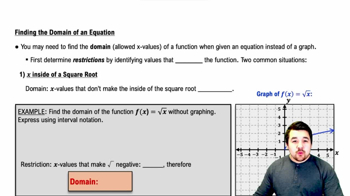
Domain of a Function
The domain of a function is the set of all input values (usually x-values) for which the function is defined. Identifying the domain is essential before analyzing behavior like increasing or decreasing intervals, especially for trigonometric functions that may have restricted domains due to their definitions or transformations.
Recommended video:
Finding the Domain of an Equation
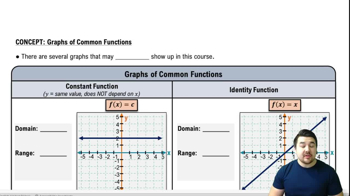
Increasing and Decreasing Functions
A function is increasing on an interval if, as the input increases, the output also increases. Formally, f is increasing on an interval if for any x1 < x2 in that interval, f(x1) < f(x2). Understanding this concept helps in determining where the function rises or falls.
Recommended video:
Graphs of Common Functions
Use of Derivatives to Determine Monotonicity
The derivative of a function indicates its rate of change. If the derivative is positive over an interval, the function is increasing there; if negative, it is decreasing. Calculating and analyzing the derivative is a key method to find the largest intervals where the function is increasing.
Recommended video:
Solve Trig Equations Using Identity Substitutions
Related Videos
Related Practice
Textbook Question
474
views