Ch. R - Algebra Review
Lial - Trigonometry 12th Edition
Lial12th EditionTrigonometryISBN: 9780136552161Not the one you use?Change textbook
Chapter 1, Problem 75b

Determine the largest open intervals of the domain over which each function is (b) decreasing. See Example 8.

Verified step by step guidance
1
Identify the function given in the problem. Since the problem references Example 8, recall the specific function from that example or write down the function explicitly to analyze its behavior.
Find the first derivative of the function, denoted as \(f'(x)\), because the sign of the derivative tells us where the function is increasing or decreasing.
Set the derivative equal to zero and solve for \(x\) to find critical points: \(f'(x) = 0\). These points divide the domain into intervals where the function's behavior may change.
Determine the sign of \(f'(x)\) on each interval between the critical points by choosing test points. If \(f'(x) < 0\) on an interval, then the function is decreasing there.
Write down the largest open intervals where \(f'(x) < 0\), which correspond to the intervals where the function is decreasing. These intervals form the solution to the problem.

Verified video answer for a similar problem:

This video solution was recommended by our tutors as helpful for the problem above.
Was this helpful?

Key Concepts

Here are the essential concepts you must grasp in order to answer the question correctly.

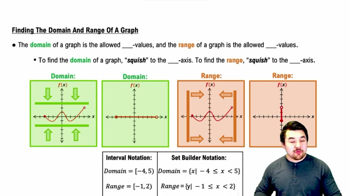
Domain and Open Intervals

The domain of a function is the set of all input values for which the function is defined. Open intervals are subsets of the domain that do not include their endpoints, often written as (a, b). Identifying the largest open intervals where a function behaves a certain way helps in understanding its overall behavior.
Recommended video:
5:10
Finding the Domain and Range of a Graph

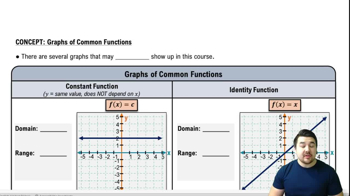
Increasing and Decreasing Functions

A function is decreasing on an interval if, for any two points in that interval, the function's value at the larger input is less than at the smaller input. This means the function's graph slopes downward over that interval. Recognizing these intervals is key to analyzing the function's monotonicity.
Recommended video:
5:57
Graphs of Common Functions

Using Derivatives to Determine Monotonicity

The derivative of a function indicates its rate of change. If the derivative is negative over an interval, the function is decreasing there. Calculating and analyzing the sign of the derivative helps identify intervals where the function decreases, which is essential for solving the problem.
Recommended video:
04:42
Solve Trig Equations Using Identity Substitutions