Ch. 7 - Applications of Trigonometry and Vectors
Lial - Trigonometry 12th Edition
Lial12th EditionTrigonometryISBN: 9780136552161Not the one you use?Change textbook
Chapter 8, Problem 59

A painter is going to apply paint to a triangular metal plate on a new building. Two sides measure 16.1 m and 15.2 m, and the angle between the sides is 125°. What is the area of the surface to be painted?

Verified step by step guidance
1
Identify the formula for the area of a triangle when two sides and the included angle are known: \( \text{Area} = \frac{1}{2}ab\sin(C) \), where \( a \) and \( b \) are the sides, and \( C \) is the included angle.
Substitute the given values into the formula: \( a = 16.1 \), \( b = 15.2 \), and \( C = 125^\circ \).
Calculate the sine of the angle: \( \sin(125^\circ) \).
Multiply the values: \( \frac{1}{2} \times 16.1 \times 15.2 \times \sin(125^\circ) \).
The result from the multiplication will give you the area of the triangular metal plate in square meters.

Verified video answer for a similar problem:

This video solution was recommended by our tutors as helpful for the problem above.
Was this helpful?

Key Concepts

Here are the essential concepts you must grasp in order to answer the question correctly.

Law of Cosines for Area Calculation

The area of a triangle can be found using two sides and the included angle with the formula: Area = 1/2 * a * b * sin(C). This method is useful when the height is unknown but two sides and the angle between them are given.
Recommended video:
4:30
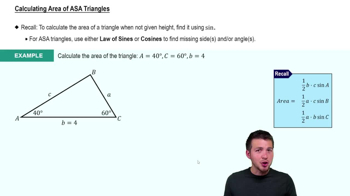
Calculating Area of ASA Triangles

Sine Function in Trigonometry

The sine of an angle in a triangle relates the angle to the ratio of the opposite side over the hypotenuse in a right triangle. In this context, sine helps calculate the height component needed to find the area when using the formula involving two sides and the included angle.
Recommended video:
6:04
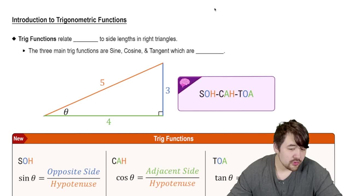
Introduction to Trigonometric Functions

Triangle Area Calculation

The area of a triangle is generally calculated as half the product of its base and height. When height is not directly known, trigonometric functions like sine allow us to find the effective height using given sides and angles.
Recommended video:
4:30
Calculating Area of ASA Triangles