In Exercises 21–40, eliminate the parameter t. Then use the rectangular equation to sketch the plane curve represented by the given parametric equations. Use arrows to show the orientation of the curve corresponding to increasing values of t. (If an interval for t is not specified, assume that −∞ < t < ∞. x = t, y = 2t
Table of contents
- 0. Review of College Algebra4h 45m
- 1. Measuring Angles40m
- 2. Trigonometric Functions on Right Triangles2h 5m
- 3. Unit Circle1h 19m
- 4. Graphing Trigonometric Functions1h 19m
- 5. Inverse Trigonometric Functions and Basic Trigonometric Equations1h 41m
- 6. Trigonometric Identities and More Equations2h 34m
- 7. Non-Right Triangles1h 38m
- 8. Vectors2h 25m
- 9. Polar Equations2h 5m
- 10. Parametric Equations1h 6m
- 11. Graphing Complex Numbers1h 7m
9. Polar Equations
Polar Coordinate System
Multiple Choice
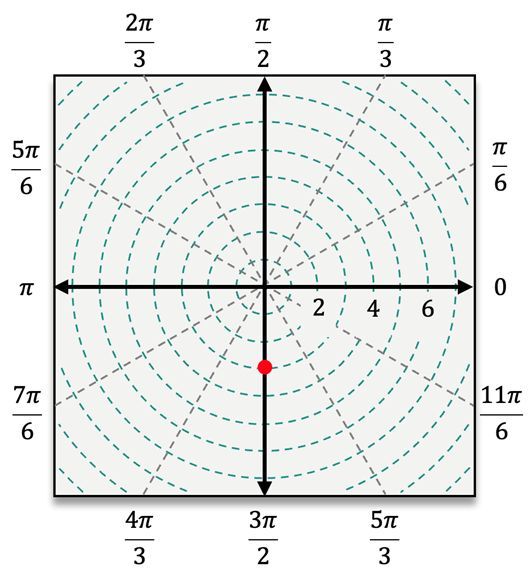
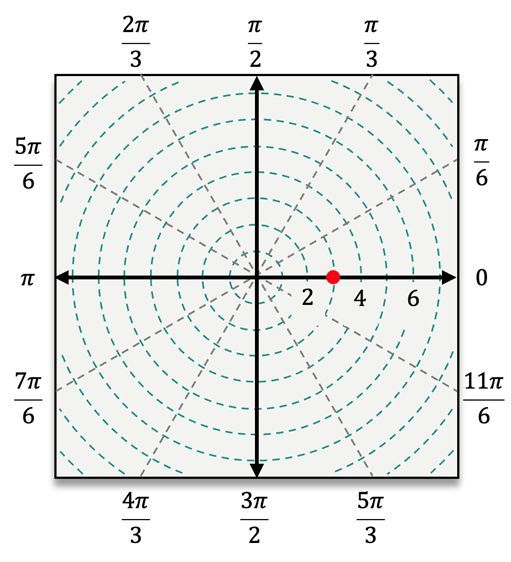
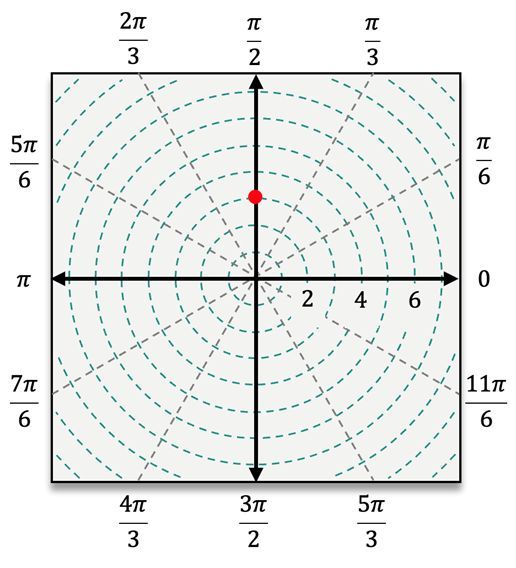
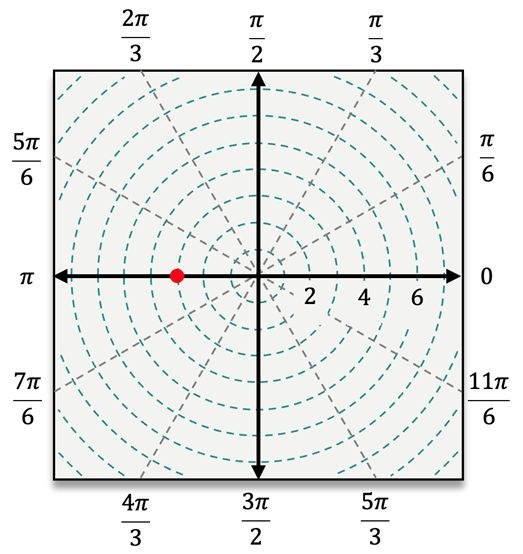
Plot the point on the polar coordinate system.
(−3,−90°)
A
B
C
D
0 Comments
Verified step by step guidance1
Understand that polar coordinates are given in the form (r, θ), where r is the radius (distance from the origin) and θ is the angle measured from the positive x-axis.
The given point is (-3, -90°). The negative radius means we will plot the point in the opposite direction of the angle.
Convert the angle from degrees to radians if necessary. Here, -90° is equivalent to -π/2 radians.
Since the radius is negative, plot the point 3 units away from the origin in the direction opposite to -90° (or -π/2 radians). This means moving 3 units in the direction of 90° (or π/2 radians).
Locate the point on the polar grid: move 3 units from the origin along the positive y-axis (since 90° corresponds to the positive y-axis).
Related Videos
Related Practice
Textbook Question
615
views

