Use point plotting to graph the plane curve described by the given parametric equations. Use arrows to show the orientation of the curve corresponding to increasing values of t. x = t − 2, y = 2t + 1; −2 ≤ t ≤ 3
Table of contents
- 0. Review of College Algebra4h 45m
- 1. Measuring Angles40m
- 2. Trigonometric Functions on Right Triangles2h 5m
- 3. Unit Circle1h 19m
- 4. Graphing Trigonometric Functions1h 19m
- 5. Inverse Trigonometric Functions and Basic Trigonometric Equations1h 41m
- 6. Trigonometric Identities and More Equations2h 34m
- 7. Non-Right Triangles1h 38m
- 8. Vectors2h 25m
- 9. Polar Equations2h 5m
- 10. Parametric Equations1h 6m
- 11. Graphing Complex Numbers1h 7m
9. Polar Equations
Polar Coordinate System
Problem 15
Textbook Question
Eliminate the parameter and graph the plane curve represented by the parametric equations. Use arrows to show the orientation of each plane curve. x = √t , y = t + 1; −∞ < t < ∞
Verified step by step guidance1
Identify the given parametric equations: \(x = \sqrt{t}\) and \(y = t + 1\), with the parameter \(t\) ranging over all real numbers.
Since \(x = \sqrt{t}\), note that \(x\) is defined only for \(t \geq 0\) because the square root of a negative number is not a real number. This restricts the domain of \(t\) to \(t \geq 0\).
Express \(t\) in terms of \(x\) by squaring both sides of the equation \(x = \sqrt{t}\), which gives \(t = x^2\).
Substitute \(t = x^2\) into the equation for \(y\): \(y = t + 1\) becomes \(y = x^2 + 1\).
The Cartesian equation of the curve is \(y = x^2 + 1\) with \(x \geq 0\). To graph, plot this parabola starting from \(x=0\) (where \(y=1\)) and moving rightward, using arrows to indicate the direction as \(t\) increases.
Verified video answer for a similar problem:This video solution was recommended by our tutors as helpful for the problem above
Video duration:
5mPlay a video:
0 Comments
Key Concepts
Here are the essential concepts you must grasp in order to answer the question correctly.
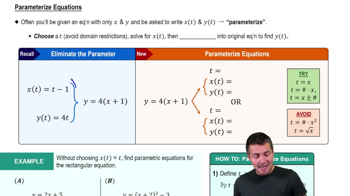
Parametric Equations
Parametric equations express the coordinates of points on a curve as functions of a parameter, often denoted as t. Instead of y as a function of x, both x and y depend on t, allowing the description of more complex curves and motions.
Recommended video:
Parameterizing Equations
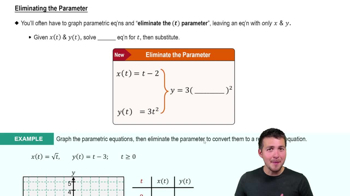
Eliminating the Parameter
Eliminating the parameter involves rewriting the parametric equations to express y directly in terms of x, removing t. This is done by solving one equation for t and substituting into the other, which helps in identifying the Cartesian form of the curve.
Recommended video:
Eliminating the Parameter
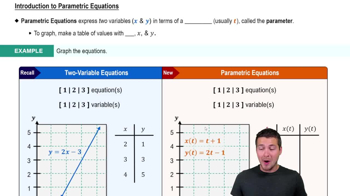
Orientation of Parametric Curves
Orientation indicates the direction in which the curve is traced as the parameter increases. Using arrows on the graph shows this direction, which is important for understanding the behavior and properties of the curve over the parameter's domain.
Recommended video:
Introduction to Parametric Equations
Related Videos
Related Practice
Textbook Question
692
views