In Exercises 21–28, an object moves in simple harmonic motion described by the given equation, where t is measured in seconds and d in inches. In each exercise, find the following: a. the maximum displacement b. the frequency c. the time required for one cycle. d = −4 sin 3π/2 t
Table of contents
- 0. Review of College Algebra4h 45m
- 1. Measuring Angles40m
- 2. Trigonometric Functions on Right Triangles2h 5m
- 3. Unit Circle1h 19m
- 4. Graphing Trigonometric Functions1h 19m
- 5. Inverse Trigonometric Functions and Basic Trigonometric Equations1h 41m
- 6. Trigonometric Identities and More Equations2h 34m
- 7. Non-Right Triangles1h 38m
- 8. Vectors2h 25m
- 9. Polar Equations2h 5m
- 10. Parametric Equations1h 6m
- 11. Graphing Complex Numbers1h 7m
4. Graphing Trigonometric Functions
Graphs of the Sine and Cosine Functions
Multiple Choice
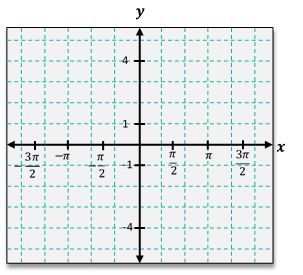
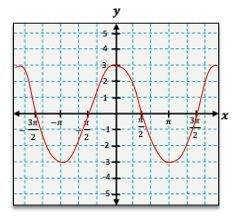
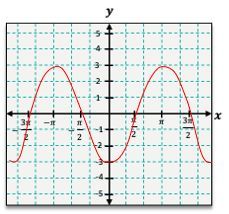
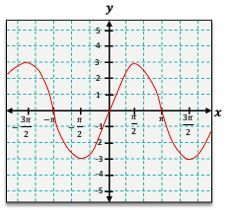
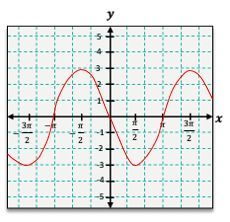
Graph the function y=−3⋅cos(x).

A
B
C
D
0 Comments
Verified step by step guidance1
Identify the function to be graphed: y = -3 * cos(x). This is a cosine function with an amplitude of 3 and a reflection over the x-axis due to the negative sign.
Determine the amplitude of the function. The amplitude is the absolute value of the coefficient of the cosine function, which is 3. This means the graph will oscillate between -3 and 3 on the y-axis.
Identify the period of the function. The period of a basic cosine function is 2π. Since there is no horizontal stretch or compression (no coefficient inside the cosine function with x), the period remains 2π.
Determine the phase shift and vertical shift. In this function, there is no horizontal or vertical shift, so the graph starts at the maximum point when x = 0, but due to the negative sign, it starts at the minimum point.
Sketch the graph using the identified characteristics: Start at the minimum point (0, -3), reach the maximum point at (π, 3), and return to the minimum point at (2π, -3). Repeat this pattern to complete the graph over the given interval.
Related Videos
Related Practice
Textbook Question
1025
views

