Table of contents
- 0. Review of College Algebra4h 45m
- 1. Measuring Angles40m
- 2. Trigonometric Functions on Right Triangles2h 5m
- 3. Unit Circle1h 19m
- 4. Graphing Trigonometric Functions1h 19m
- 5. Inverse Trigonometric Functions and Basic Trigonometric Equations1h 41m
- 6. Trigonometric Identities and More Equations2h 34m
- 7. Non-Right Triangles1h 38m
- 8. Vectors2h 25m
- 9. Polar Equations2h 5m
- 10. Parametric Equations1h 6m
- 11. Graphing Complex Numbers1h 7m
1. Measuring Angles
Angles in Standard Position
Problem 1.1.53
Textbook Question
In Exercises 41–56, use the circle shown in the rectangular coordinate system to draw each angle in standard position. State the quadrant in which the angle lies. When an angle's measure is given in radians, work the exercise without converting to degrees.

-210°
Verified step by step guidance1
Understand that the angle is given as -210°, which means it is measured clockwise from the positive x-axis because the angle is negative.
Since a full circle is 360°, find the equivalent positive angle by adding 360° to -210°: \(-210° + 360° = 150°\).
Draw the angle 150° in standard position, which means starting from the positive x-axis and rotating counterclockwise 150°.
Locate the quadrant where 150° lies. Since 150° is between 90° and 180°, the angle lies in the second quadrant.
Mark the terminal side of the angle on the circle in the second quadrant, which corresponds to the position of 150°.
Verified video answer for a similar problem:This video solution was recommended by our tutors as helpful for the problem above
Video duration:
2mPlay a video:
0 Comments
Key Concepts
Here are the essential concepts you must grasp in order to answer the question correctly.
Standard Position of an Angle
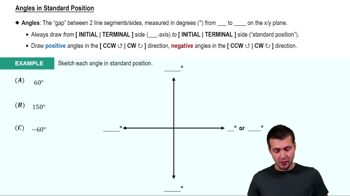
An angle is in standard position when its vertex is at the origin of the coordinate system and its initial side lies along the positive x-axis. The angle is measured by rotating the terminal side from the initial side, either counterclockwise for positive angles or clockwise for negative angles.
Recommended video:
Drawing Angles in Standard Position
Quadrants in the Coordinate Plane
The coordinate plane is divided into four quadrants by the x- and y-axes. Quadrant I has positive x and y values, Quadrant II has negative x and positive y, Quadrant III has negative x and y, and Quadrant IV has positive x and negative y. The quadrant where the terminal side of the angle lies determines the sign of trigonometric functions.
Recommended video:
Quadratic Formula
Measuring Angles in Degrees and Radians
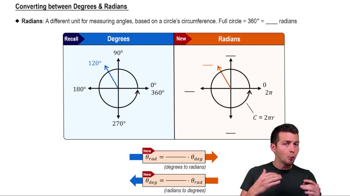
Angles can be measured in degrees or radians. Degrees divide a circle into 360 parts, while radians measure angles based on the radius of the circle, with 2π radians equal to 360 degrees. For this problem, angles are given in degrees and should be used directly to locate the terminal side without converting to radians.
Recommended video:
Converting between Degrees & Radians
Related Videos
Related Practice
Textbook Question
In Exercises 41–56, use the circle shown in the rectangular coordinate system to draw each angle in standard position. State the quadrant in which the angle lies. When an angle's measure is given in radians, work the exercise without converting to degrees._ 7𝜋4
470
views