
Textbook Question
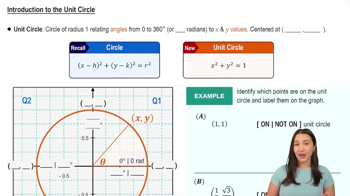
In Exercises 8–12, draw each angle in standard position. 5𝜋 6
771
views


 Verified step by step guidance
 06:11
06:11
 6:34
6:34 04:39
04:39In Exercises 8–12, draw each angle in standard position. 5𝜋 6
In Exercises 5–7, convert each angle in radians to degrees. - 5𝜋 6
In Exercises 9–16, use the given triangles to evaluate each expression. If necessary, express the value without a square root in the denominator by rationalizing the denominator.
cos 30°
In Exercises 7–12, find the radian measure of the central angle of a circle of radius r that intercepts an arc of length s. Radius, r: 6 yards Arc Length, s: 8 yards
In Exercises 8–13, find the exact value of each expression. Do not use a calculator. tan 300°
In Exercises 1–8, a point on the terminal side of angle θ is given. Find the exact value of each of the six trigonometric functions of θ. (-1, -3)