Ch. 4 - Laws of Sines and Cosines; Vectors
Blitzer - Trigonometry 3rd Edition
Blitzer3rd EditionTrigonometryISBN: 9780137316601Not the one you use?Change textbook
Chapter 4, Problem 3c

In Exercises 1–4, u and v have the same direction. In each exercise: Is u = v? Explain.

Verified step by step guidance
1
Understand that two vectors \( \mathbf{u} \) and \( \mathbf{v} \) having the same direction means they are scalar multiples of each other. This implies \( \mathbf{u} = k \mathbf{v} \) for some scalar \( k > 0 \).
Recall that for \( \mathbf{u} = \mathbf{v} \) to be true, both the magnitude (length) and direction of \( \mathbf{u} \) and \( \mathbf{v} \) must be exactly the same.
Since \( \mathbf{u} \) and \( \mathbf{v} \) have the same direction, check if their magnitudes are equal by comparing \( |\mathbf{u}| \) and \( |\mathbf{v}| \).
If \( |\mathbf{u}| = |\mathbf{v}| \), then \( k = 1 \) and \( \mathbf{u} = \mathbf{v} \). Otherwise, if \( |\mathbf{u}| \neq |\mathbf{v}| \), then \( \mathbf{u} \neq \mathbf{v} \) even though they point in the same direction.
Summarize your conclusion by stating that having the same direction does not guarantee \( \mathbf{u} = \mathbf{v} \); equality requires both direction and magnitude to be identical.

Verified video answer for a similar problem:

This video solution was recommended by our tutors as helpful for the problem above.
Video duration:
6m
Was this helpful?

Key Concepts

Here are the essential concepts you must grasp in order to answer the question correctly.

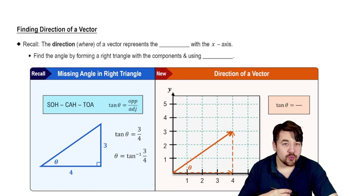
Vector Direction

Vector direction refers to the orientation of a vector in space, independent of its magnitude. Two vectors have the same direction if they lie along the same line or parallel lines, pointing either the same way or exactly opposite. Understanding direction is crucial to compare vectors beyond just their lengths.
Recommended video:
05:13
Finding Direction of a Vector

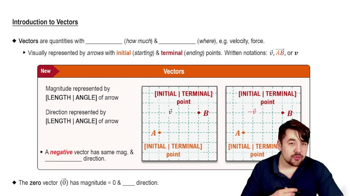
Vector Equality

Two vectors are equal if and only if they have the same magnitude and the same direction. Even if vectors share the same direction, they are not equal unless their lengths are identical. This concept helps determine when vectors represent the same quantity.
Recommended video:
03:48
Introduction to Vectors

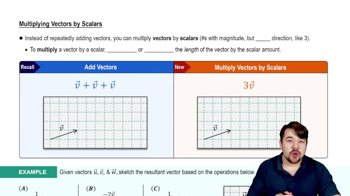
Scalar Multiplication of Vectors

Scalar multiplication changes a vector's magnitude without altering its direction, unless the scalar is negative, which reverses the direction. Recognizing how scaling affects vectors is essential to understand when vectors with the same direction differ in magnitude and thus are not equal.
Recommended video:
05:05
Multiplying Vectors By Scalars