For each expression in Column I, use an identity to choose an expression from Column II with the same value. Choices may be used once, more than once, or not at all. cos 75°
Verified step by step guidance
1
Recognize that 75° can be expressed as the sum of two special angles whose cosine and sine values are well known, for example, 75° = 45° + 30°.
Use the cosine addition formula: \(\cos(A + B) = \cos A \cos B - \sin A \sin B\).
Substitute \(A = 45^\circ\) and \(B = 30^\circ\) into the formula to get \(\cos 75^\circ = \cos 45^\circ \cos 30^\circ - \sin 45^\circ \sin 30^\circ\).
Combine these values into the expression to find an equivalent expression for \(\cos 75^\circ\) that matches one of the options in Column II.
Verified video answer for a similar problem:
This video solution was recommended by our tutors as helpful for the problem above
Play a video:
0 Comments
Key Concepts
Here are the essential concepts you must grasp in order to answer the question correctly.
Angle Sum and Difference Identities
These identities express the sine or cosine of a sum or difference of angles in terms of the sines and cosines of the individual angles. For example, cos(75°) can be written as cos(45° + 30°) and expanded using cos(A + B) = cos A cos B - sin A sin B.
Verifying Identities with Sum and Difference Formulas
Exact Values of Special Angles
Certain angles like 30°, 45°, and 60° have known exact sine and cosine values. Knowing these values allows you to compute expressions like cos(75°) by breaking it into sums or differences of these special angles.
This concept involves recognizing when two trigonometric expressions represent the same value, often by applying identities or simplifications. It is essential for matching expressions from different forms, such as matching cos 75° to an equivalent expression in another form.

 Verified step by step guidance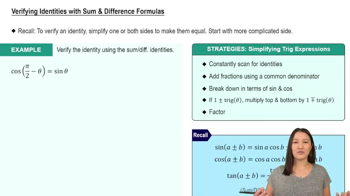
 2:25
2:25