
Ch. 5 - Trigonometric Identities
Lial - Trigonometry 12th Edition
Lial12th EditionTrigonometryISBN: 9780136552161Not the one you use?Change textbook
Chapter 6, Problem 5.22

Perform each indicated operation and simplify the result so that there are no quotients.
1/( sin α - 1) - 1/(sin α + 1)

Verified step by step guidance
1
Identify a common denominator for the two fractions. The common denominator is \((\sin \alpha - 1)(\sin \alpha + 1)\).
Rewrite each fraction with the common denominator: \(\frac{1}{\sin \alpha - 1} = \frac{\sin \alpha + 1}{(\sin \alpha - 1)(\sin \alpha + 1)}\) and \(\frac{1}{\sin \alpha + 1} = \frac{\sin \alpha - 1}{(\sin \alpha - 1)(\sin \alpha + 1)}\).
Subtract the two fractions: \(\frac{\sin \alpha + 1}{(\sin \alpha - 1)(\sin \alpha + 1)} - \frac{\sin \alpha - 1}{(\sin \alpha - 1)(\sin \alpha + 1)}\).
Combine the numerators over the common denominator: \(\frac{(\sin \alpha + 1) - (\sin \alpha - 1)}{(\sin \alpha - 1)(\sin \alpha + 1)}\).
Simplify the numerator: \((\sin \alpha + 1) - (\sin \alpha - 1) = 2\), resulting in \(\frac{2}{(\sin \alpha - 1)(\sin \alpha + 1)}\).

Verified video answer for a similar problem:

This video solution was recommended by our tutors as helpful for the problem above.
Was this helpful?

Key Concepts

Here are the essential concepts you must grasp in order to answer the question correctly.

Trigonometric Functions

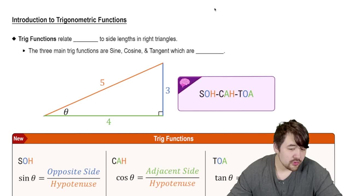
Trigonometric functions, such as sine, cosine, and tangent, relate angles to the ratios of sides in right triangles. In this question, the sine function is used, which is defined as the ratio of the length of the opposite side to the hypotenuse in a right triangle. Understanding how these functions behave and their properties is essential for manipulating expressions involving them.
Recommended video:
6:04
Introduction to Trigonometric Functions

Common Denominator

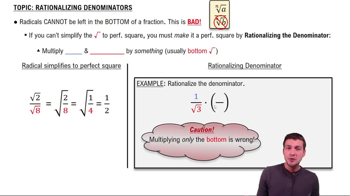
When performing operations with fractions, finding a common denominator is crucial for combining them. In this case, the two fractions have different denominators: (sin α - 1) and (sin α + 1). To simplify the expression, one must find a common denominator, which is the product of the two denominators, allowing for the combination of the fractions into a single expression.
Recommended video:
2:58
Rationalizing Denominators

Simplification of Expressions

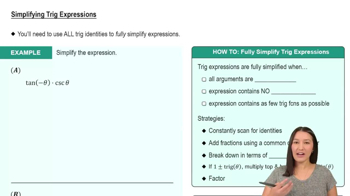
Simplification involves reducing an expression to its simplest form, often by eliminating common factors or combining like terms. In this problem, after finding a common denominator and combining the fractions, further simplification may involve factoring or canceling terms. This process is essential to ensure the final result is presented without quotients, as specified in the question.
Recommended video:
6:36
Simplifying Trig Expressions