Solve each problem. Rotating Pulley A pulley is rotating 320 times per min. Through how many degrees does a point on the edge of the pulley move in 2/3 sec?
Table of contents
- 0. Review of College Algebra4h 43m
- 1. Measuring Angles40m
- 2. Trigonometric Functions on Right Triangles2h 5m
- 3. Unit Circle1h 19m
- 4. Graphing Trigonometric Functions1h 19m
- 5. Inverse Trigonometric Functions and Basic Trigonometric Equations1h 41m
- 6. Trigonometric Identities and More Equations2h 34m
- 7. Non-Right Triangles1h 38m
- 8. Vectors2h 25m
- 9. Polar Equations2h 5m
- 10. Parametric Equations1h 6m
- 11. Graphing Complex Numbers1h 7m
1. Measuring Angles
Angles in Standard Position
Problem 2
Textbook Question
CONCEPT PREVIEW Match each trigonometric function value or angle in Column I with its appropriate approximation in Column II.
Column I:
cos⁻¹ 0.45
Column II:
A. 88.09084757°
B. 63.25631605°
C. 1.909152433°
D. 17.45760312°
E. 0.2867453858
F. 1.962610506
G. 14.47751219°
H. 1.015426612
I. 1.051462224
J. 0.9925461516
Verified step by step guidance1
Identify the trigonometric functions or inverse functions given in Column I. For example, recognize expressions like \( \cos^{-1}(0.45) \) as an inverse cosine function, which will give an angle in degrees or radians.
Calculate or recall the approximate values of the given trigonometric expressions. For inverse cosine, use the formula \( \theta = \cos^{-1}(x) \) where \( x = 0.45 \), and find the angle \( \theta \) in degrees or radians as appropriate.
Match each calculated angle or function value from Column I with the closest numerical approximation listed in Column II. Pay attention to whether the values are in degrees or radians to ensure correct matching.
For values that are angles, confirm if they are given in degrees (usually indicated by the degree symbol \( ^\circ \)) or radians (decimal numbers without the degree symbol). This helps to avoid mismatches between angle units.
Systematically pair each item from Column I with the corresponding value in Column II by comparing the numerical approximations, ensuring that inverse functions correspond to angles and function values correspond to decimal approximations.
Verified video answer for a similar problem:This video solution was recommended by our tutors as helpful for the problem above
Video duration:
1mPlay a video:
0 Comments
Key Concepts
Here are the essential concepts you must grasp in order to answer the question correctly.
Inverse Trigonometric Functions
Inverse trigonometric functions, such as cos⁻¹ (arccos), return the angle whose trigonometric function equals a given value. For example, cos⁻¹(0.45) gives the angle whose cosine is 0.45. Understanding these functions is essential for converting between function values and angles.
Recommended video:
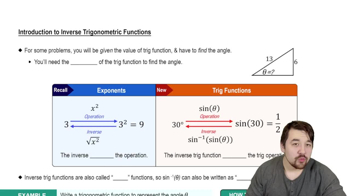
Introduction to Inverse Trig Functions
Angle Measurement Units
Angles can be measured in degrees or radians. Degrees divide a circle into 360 parts, while radians relate the angle to the radius of a circle. Recognizing the unit used is crucial for matching approximate values correctly and interpreting trigonometric results.
Recommended video:
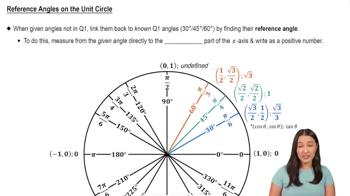
Reference Angles on the Unit Circle
Approximation and Matching Values
Matching trigonometric values to their approximate angles requires understanding numerical approximations and how to interpret decimal values as angles or function outputs. This skill helps in identifying which angle corresponds to a given trigonometric value or vice versa.
Recommended video:
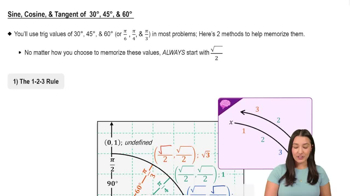
Sine, Cosine, & Tangent of 30°, 45°, & 60°
Related Videos
Related Practice
Textbook Question
510
views