Graph each function over a two-period interval. y = 1 - 2 cos ((1/2)x)
Verified step by step guidance
1
Identify the given function: \(y = 1 - 2 \cos\left(\frac{1}{2}x\right)\).
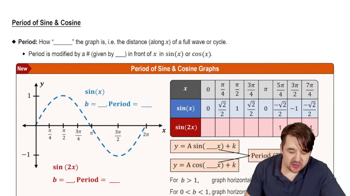
Determine the period of the cosine function. Recall that the period of \(\cos(bx)\) is given by \(\frac{2\pi}{b}\). Here, \(b = \frac{1}{2}\), so the period is \(\frac{2\pi}{\frac{1}{2}} = 4\pi\).
Since the problem asks to graph over a two-period interval, calculate the interval length: \(2 \times 4\pi = 8\pi\). So, the graph should be drawn for \(x\) in the interval \([0, 8\pi]\) (or any other interval of length \(8\pi\)).
Find key points within one period to plot: evaluate \(y\) at \(x = 0, 2\pi, 4\pi\) (these correspond to \$0\(, \(\pi\), and \(2\pi\) inside the cosine argument after multiplying by \(\frac{1}{2}\)). Calculate \)y$ values at these points to understand the shape.
Use the amplitude and vertical shift to sketch the graph: amplitude is \$2\( (from the coefficient of cosine), and the vertical shift is \)+1\(. The cosine function oscillates between \)-1\( and \)1\(, so \)y\( oscillates between \)1 - 2(1) = -1\( and \)1 - 2(-1) = 3$. Plot these points and connect smoothly to complete two periods.
Verified video answer for a similar problem:
This video solution was recommended by our tutors as helpful for the problem above
Play a video:
0 Comments
Key Concepts
Here are the essential concepts you must grasp in order to answer the question correctly.
Amplitude and Vertical Shift of Trigonometric Functions
The amplitude of a cosine function is the absolute value of the coefficient before the cosine, indicating the maximum deviation from the midline. The vertical shift moves the entire graph up or down by a constant value, determined by the added or subtracted constant outside the cosine term. In y = 1 - 2 cos((1/2)x), the amplitude is 2 and the vertical shift is +1.
The period of a cosine function is the length of one complete cycle and is calculated as 2π divided by the coefficient of x inside the cosine. For y = 1 - 2 cos((1/2)x), the coefficient is 1/2, so the period is 2π ÷ (1/2) = 4π. Graphing over two periods means plotting from 0 to 8π.
Graphing involves plotting key points such as maxima, minima, and intercepts based on amplitude, period, and phase shifts. For cosine functions, start at the maximum point, then mark quarter-period intervals to identify zeros and minima. Adjust these points according to vertical shifts and amplitude to accurately sketch the graph.