Recognize that the expression \( \sqrt{\frac{1 + \cos 76^\circ}{2}} \) is related to a trigonometric identity.
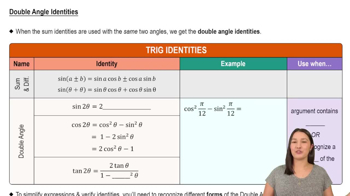
Recall the half-angle identity for cosine: \( \cos \left( \frac{\theta}{2} \right) = \sqrt{\frac{1 + \cos \theta}{2}} \).
Identify that \( \theta = 76^\circ \) in the given expression, so we are looking for \( \cos \left( \frac{76^\circ}{2} \right) \).
Calculate \( \frac{76^\circ}{2} \) to find the angle for which we need the cosine value.
Express the simplified form as \( \cos \left( 38^\circ \right) \).
Verified video answer for a similar problem:
This video solution was recommended by our tutors as helpful for the problem above
Play a video:
0 Comments
Key Concepts
Here are the essential concepts you must grasp in order to answer the question correctly.
Cosine Function
The cosine function is a fundamental trigonometric function that relates the angle of a right triangle to the ratio of the length of the adjacent side to the hypotenuse. In the context of the expression given, cos 76° represents the cosine of 76 degrees, which is a specific value that can be calculated or approximated using a calculator or trigonometric tables.
The half-angle identities are formulas that express trigonometric functions of half angles in terms of the functions of the original angle. For example, the identity for cosine states that cos(θ/2) = √[(1 + cos θ)/2]. This identity is particularly useful for simplifying expressions involving angles that are halved, such as the expression in the question.
The square root function is a mathematical operation that finds a number which, when multiplied by itself, gives the original number. In the expression √[(1 + cos 76°)/2], the square root is applied to the result of the fraction, which simplifies the expression further. Understanding how to manipulate square roots is essential for simplifying trigonometric expressions effectively.

 Verified step by step guidance
 5:53
5:53