Use trigonometric function values of quadrantal angles to evaluate each expression. [cos(―180°)]² + [sin(― 180°)]²
Table of contents
- 0. Review of College Algebra4h 45m
- 1. Measuring Angles40m
- 2. Trigonometric Functions on Right Triangles2h 5m
- 3. Unit Circle1h 19m
- 4. Graphing Trigonometric Functions1h 19m
- 5. Inverse Trigonometric Functions and Basic Trigonometric Equations1h 41m
- 6. Trigonometric Identities and More Equations2h 34m
- 7. Non-Right Triangles1h 38m
- 8. Vectors2h 25m
- 9. Polar Equations2h 5m
- 10. Parametric Equations1h 6m
- 11. Graphing Complex Numbers1h 7m
2. Trigonometric Functions on Right Triangles
Trigonometric Functions on Right Triangles
Problem 106
Textbook Question
If n is an integer, n • 180° represents an integer multiple of 180°, (2n + 1) • 90° represents an odd integer multiple of 90° , and so on. Determine whether each expression is equal to 0, 1, or ―1, or is undefined. cos[n • 360°]
Verified step by step guidance1
Recognize that the expression is \( \cos[n \cdot 360^\circ] \), where \( n \) is an integer.
Recall the periodicity of the cosine function: \( \cos(\theta) = \cos(\theta + 360^\circ) \) for any angle \( \theta \).
Since \( n \) is an integer, \( n \cdot 360^\circ \) represents full rotations around the unit circle, landing back at the starting point.
Therefore, \( \cos[n \cdot 360^\circ] = \cos(0^\circ) \), because rotating by full circles does not change the cosine value.
Recall that \( \cos(0^\circ) = 1 \), so the expression evaluates to 1 for any integer \( n \).
Verified video answer for a similar problem:This video solution was recommended by our tutors as helpful for the problem above
Video duration:
2mPlay a video:
0 Comments
Key Concepts
Here are the essential concepts you must grasp in order to answer the question correctly.
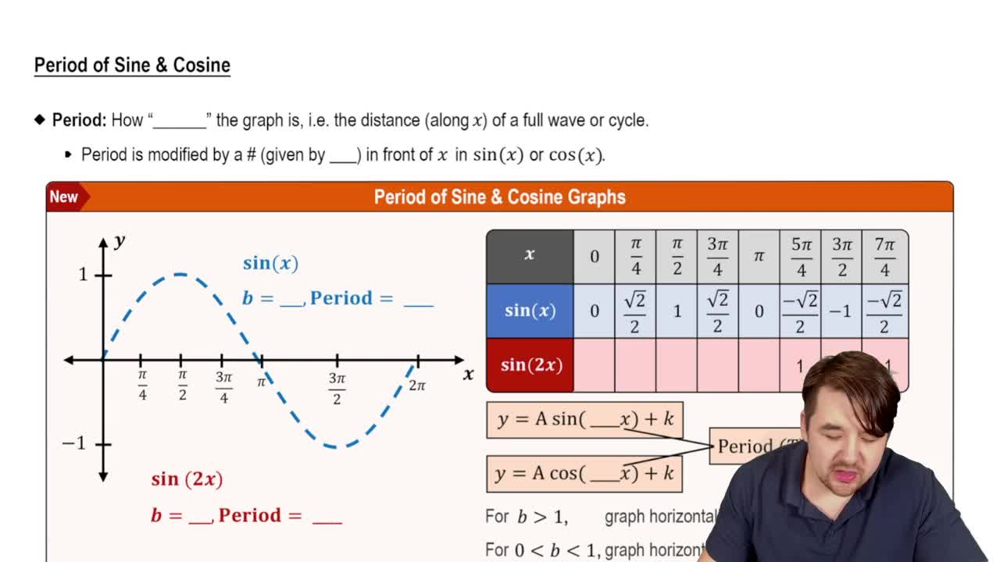
Periodic Nature of the Cosine Function
The cosine function is periodic with a period of 360°, meaning cos(θ) = cos(θ + 360°k) for any integer k. This property allows simplification of angles by reducing them modulo 360°, which is essential for evaluating expressions like cos(n • 360°).
Recommended video:
Period of Sine and Cosine Functions
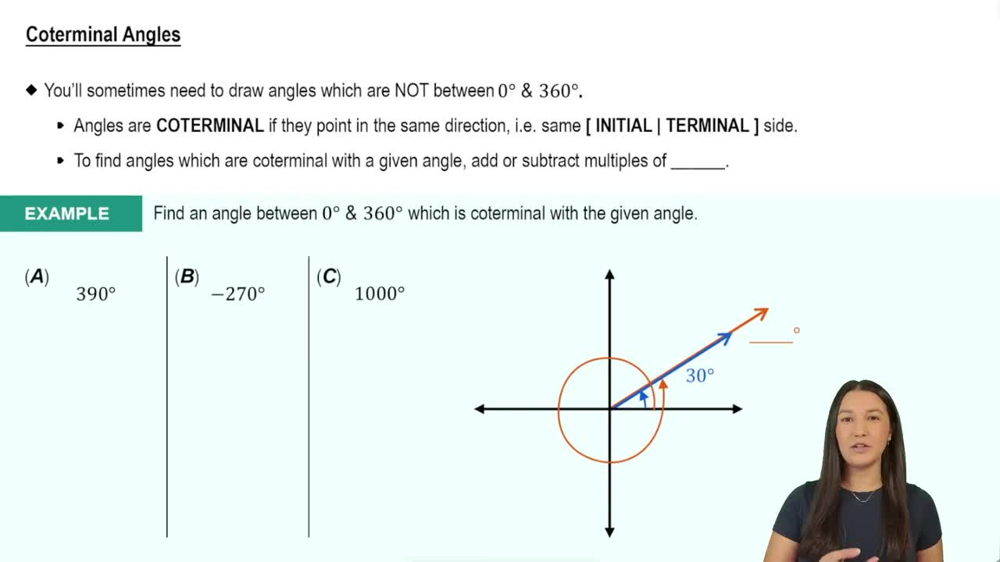
Integer Multiples of Angles
When an angle is expressed as an integer multiple of a base angle (e.g., n • 360°), it helps identify patterns in trigonometric values. For cosine, multiples of 360° correspond to full rotations, which return the function to its initial value, simplifying evaluation.
Recommended video:
Coterminal Angles
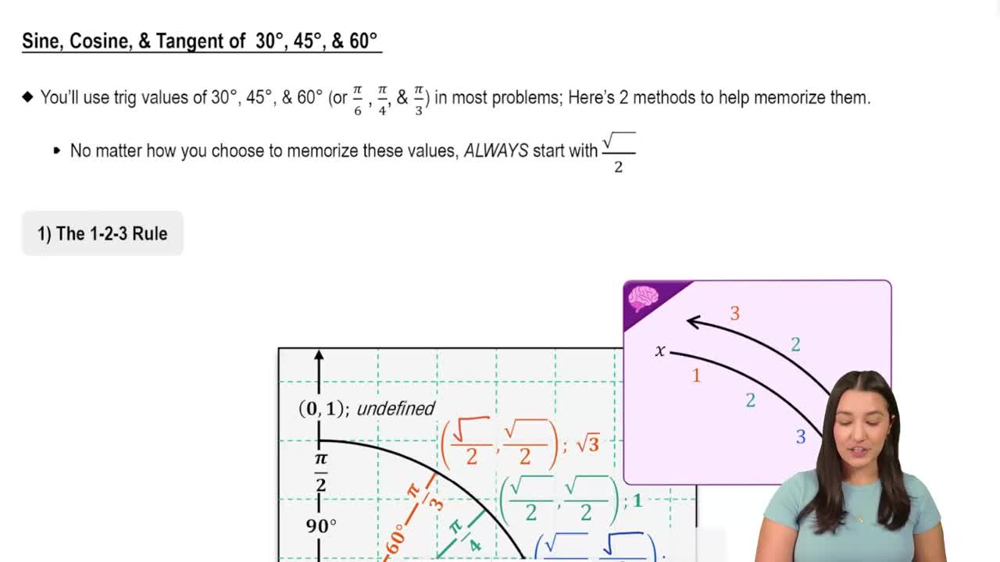
Values of Cosine at Special Angles
Cosine values at key angles such as 0°, 90°, 180°, 270°, and 360° are well-known: cos(0°) = 1, cos(90°) = 0, cos(180°) = -1, etc. Recognizing these values helps determine the output of cosine expressions involving multiples of these angles, like cos(n • 360°) = 1.
Recommended video:
Sine, Cosine, & Tangent of 30°, 45°, & 60°
Related Videos
Related Practice
Textbook Question
583
views