Ch. 3 - Trigonometric Identities and Equations
Blitzer - Trigonometry 3rd Edition
Blitzer3rd EditionTrigonometryISBN: 9780137316601Not the one you use?Change textbook
Chapter 3, Problem 129

In Exercises 127–130, solve each equation on the interval [0, 2𝝅) by first rewriting the equation in terms of sines or cosines. sec² x + 3 sec x + 2 = 0

Verified step by step guidance
1
Recall that secant is the reciprocal of cosine, so rewrite the equation in terms of cosine: replace \( \sec x \) with \( \frac{1}{\cos x} \). The equation becomes \( \left( \frac{1}{\cos x} \right)^2 + 3 \left( \frac{1}{\cos x} \right) + 2 = 0 \).
Multiply through the entire equation by \( \cos^2 x \) to clear the denominators, resulting in a quadratic equation in terms of \( \cos x \): \( 1 + 3 \cos x + 2 \cos^2 x = 0 \).
Rewrite the quadratic equation in standard form: \( 2 \cos^2 x + 3 \cos x + 1 = 0 \).
Use the quadratic formula or factoring to solve for \( \cos x \). The quadratic formula is \( \cos x = \frac{-b \pm \sqrt{b^2 - 4ac}}{2a} \), where \( a=2 \), \( b=3 \), and \( c=1 \).
Find all values of \( x \) in the interval \( [0, 2\pi) \) such that \( \cos x \) equals the solutions found. Use the unit circle or inverse cosine function to determine these angles.

Verified video answer for a similar problem:

This video solution was recommended by our tutors as helpful for the problem above.
Video duration:
5m
Was this helpful?

Key Concepts

Here are the essential concepts you must grasp in order to answer the question correctly.

Secant Function and Its Relationship to Cosine

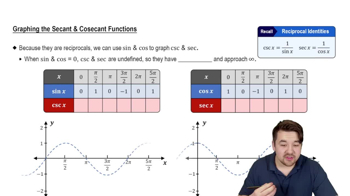
The secant function, sec x, is the reciprocal of the cosine function, defined as sec x = 1/cos x. Understanding this relationship allows rewriting equations involving sec x in terms of cosine, which is often easier to solve.
Recommended video:
6:22
Graphs of Secant and Cosecant Functions

Solving Quadratic Equations in Trigonometric Functions

Trigonometric equations like sec² x + 3 sec x + 2 = 0 can be treated as quadratic equations by substituting a trigonometric expression (e.g., sec x = y). Solving the quadratic yields values for the trigonometric function, which can then be used to find the angle solutions.
Recommended video:
6:24
Solving Quadratic Equations by Completing the Square

Finding Solutions on a Specific Interval [0, 2π)

When solving trigonometric equations, it is important to find all solutions within the given interval, here [0, 2π). This involves considering the periodicity of sine and cosine functions and checking all possible angles that satisfy the equation within one full rotation.
Recommended video:
4:03
Inverse Sine