Given the line with parametric equations , , , find the perpendicular distance from the point to the line.
Table of contents
- 0. Review of College Algebra4h 45m
- 1. Measuring Angles40m
- 2. Trigonometric Functions on Right Triangles2h 5m
- 3. Unit Circle1h 19m
- 4. Graphing Trigonometric Functions1h 19m
- 5. Inverse Trigonometric Functions and Basic Trigonometric Equations1h 41m
- 6. Trigonometric Identities and More Equations2h 34m
- 7. Non-Right Triangles1h 38m
- 8. Vectors2h 25m
- 9. Polar Equations2h 5m
- 10. Parametric Equations1h 6m
- 11. Graphing Complex Numbers1h 7m
8. Vectors
Geometric Vectors
Problem 27
Textbook Question
Two forces act on a point in the plane. The angle between the two forces is given. Find the magnitude of the resultant force.
forces of 250 and 450 newtons, forming an angle of 85°
Verified step by step guidance1
Identify the two forces and the angle between them. Here, the forces are 250 N and 450 N, and the angle between them is 85°.
Recall the formula for the magnitude of the resultant force when two forces act at an angle \( \theta \):
\[ R = \sqrt{F_1^2 + F_2^2 + 2 F_1 F_2 \cos(\theta)} \]
Substitute the given values into the formula:
\[ R = \sqrt{250^2 + 450^2 + 2 \times 250 \times 450 \times \cos(85^\circ)} \]
Calculate the cosine of the angle \( \cos(85^\circ) \) using a calculator or trigonometric tables.
Evaluate the expression inside the square root step-by-step, then take the square root to find the magnitude of the resultant force.
Verified video answer for a similar problem:This video solution was recommended by our tutors as helpful for the problem above
Play a video:
0 Comments
Key Concepts
Here are the essential concepts you must grasp in order to answer the question correctly.
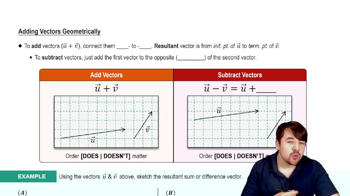
Vector Addition of Forces
Forces acting at a point can be represented as vectors. The resultant force is found by vector addition, combining both magnitude and direction. Understanding how to add vectors graphically or analytically is essential to determine the overall effect of multiple forces.
Recommended video:
Adding Vectors Geometrically
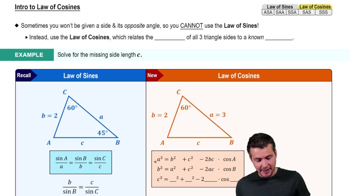
Law of Cosines
The Law of Cosines relates the lengths of sides in a triangle to the cosine of one of its angles. It is used to find the magnitude of the resultant vector when two vectors form a known angle, by treating the forces as sides of a triangle and the resultant as the third side.
Recommended video:
Intro to Law of Cosines
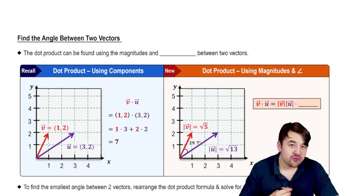
Angle Between Vectors
The angle between two forces affects the magnitude of their resultant. Knowing how to use the given angle in calculations, especially in the Law of Cosines formula, is crucial to accurately compute the resultant force magnitude.
Recommended video:
Find the Angle Between Vectors
Related Videos
Related Practice
Multiple Choice
53
views