Identify that in the given expression, \( \theta = 18x \), so the expression represents \( \cos \frac{18x}{2} \).
Simplify \( \cos \frac{18x}{2} \) to \( \cos 9x \).
Conclude that the expression \( \pm \sqrt{\frac{1 + \cos 18x}{2}} \) simplifies to \( \pm \cos 9x \).
Verified video answer for a similar problem:
This video solution was recommended by our tutors as helpful for the problem above
Play a video:
0 Comments
Key Concepts
Here are the essential concepts you must grasp in order to answer the question correctly.
Cosine Function
The cosine function is a fundamental trigonometric function that relates the angle of a right triangle to the ratio of the length of the adjacent side to the hypotenuse. It is periodic and oscillates between -1 and 1. Understanding the properties of the cosine function is essential for simplifying expressions involving cosine, such as the one in the question.
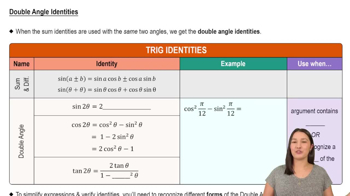
The half-angle identities are trigonometric identities that express trigonometric functions of half an angle in terms of the functions of the original angle. For cosine, the half-angle identity is cos(θ/2) = ±√[(1 + cos θ)/2]. This identity is crucial for simplifying expressions like ±√[(1 + cos 18x)/2] by recognizing it as a half-angle formula.
Square root properties involve the rules governing the manipulation of square roots, including the principle that √(a/b) = √a/√b and √(a) * √(a) = a. These properties are important for simplifying expressions under the square root, allowing for the extraction of factors and simplification of trigonometric expressions effectively.

 Verified step by step guidance
 5:53
5:53