Step 4: Find a common denominator for \( \frac{9}{16} \) and \( \frac{4}{9} \) to add them together.
Step 5: Check if the sum of \( \frac{9}{16} \) and \( \frac{4}{9} \) equals 1 to determine if such an angle \( \theta \) exists.
Verified video answer for a similar problem:
This video solution was recommended by our tutors as helpful for the problem above
Video duration:
3m
Play a video:
0 Comments
Key Concepts
Here are the essential concepts you must grasp in order to answer the question correctly.
Pythagorean Identity
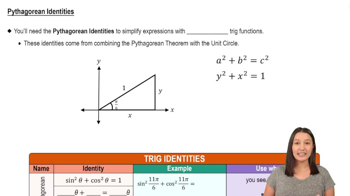
The Pythagorean identity states that for any angle θ, the square of the sine and cosine functions must satisfy the equation sin²(θ) + cos²(θ) = 1. This identity is fundamental in trigonometry as it relates the two primary trigonometric functions and helps verify the validity of given function values.
The sine and cosine functions have specific ranges: sin(θ) ranges from -1 to 1, and cos(θ) also ranges from -1 to 1. Understanding these ranges is crucial when determining if certain function values are possible for a given angle θ, as any values outside these ranges are invalid.
In trigonometry, the existence of an angle θ that satisfies given sine and cosine values can be determined by checking if the values adhere to the Pythagorean identity. If the values do not satisfy this identity, it indicates that no such angle exists, which is essential for solving problems involving trigonometric functions.