Concept Check Work each problem.Without using a calculator, determine which of the following numbers is closest to sin 115°: -0.9, -0.1, 0, 0.1, or 0.9.
Verified step by step guidance
1
Step 1: Recall that the sine function is positive in the second quadrant, where angles range from 90° to 180°.
Step 2: Recognize that 115° is in the second quadrant, so sin 115° should be positive.
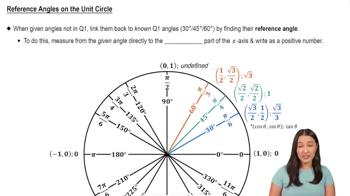
Step 3: Use the reference angle concept: the reference angle for 115° is 180° - 115° = 65°.
Step 4: Know that sin 65° is a positive value and is closer to 1 than to 0, but not very close to 1.
Step 5: Compare the given options: -0.9, -0.1, 0, 0.1, and 0.9, and identify which positive value is reasonable for sin 115°.
Verified video answer for a similar problem:
This video solution was recommended by our tutors as helpful for the problem above
Video duration:
3m
Play a video:
0 Comments
Key Concepts
Here are the essential concepts you must grasp in order to answer the question correctly.
Unit Circle
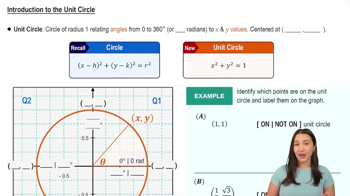
The unit circle is a fundamental concept in trigonometry that defines the sine and cosine of angles. It is a circle with a radius of one centered at the origin of a coordinate plane. The coordinates of any point on the unit circle correspond to the cosine and sine values of the angle formed with the positive x-axis. Understanding the unit circle helps in visualizing and calculating trigonometric functions for various angles.
The sine function, denoted as sin(θ), represents the ratio of the length of the opposite side to the hypotenuse in a right triangle. It is also defined on the unit circle as the y-coordinate of a point corresponding to a given angle θ. The sine function oscillates between -1 and 1, and its values can be determined for specific angles, such as 0°, 30°, 45°, 60°, and 90°, which are commonly used in trigonometric calculations.
Reference angles are the acute angles formed by the terminal side of an angle and the x-axis. They are crucial for determining the sine and cosine values of angles greater than 90° or less than 0°. For example, to find sin(115°), we can use its reference angle, which is 180° - 115° = 65°. This helps in understanding the sine value's sign and magnitude based on the quadrant in which the angle lies.