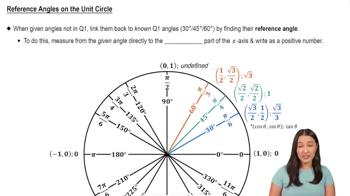
Step 1: Understand that the reference angle is the smallest angle that the terminal side of a given angle makes with the x-axis.
Step 2: Convert the given angle from radians to degrees if necessary. However, since the problem is in radians, we will work with radians directly.
Step 3: Recognize that the angle \( \frac{5\pi}{4} \) is in the third quadrant because it is greater than \( \pi \) (which is \( 180^\circ \)) and less than \( \frac{3\pi}{2} \) (which is \( 270^\circ \)).
Step 4: To find the reference angle for an angle in the third quadrant, subtract \( \pi \) from the given angle. So, calculate \( \frac{5\pi}{4} - \pi \).
Step 5: Simplify the expression from Step 4 to find the reference angle in radians.
Verified video answer for a similar problem:
This video solution was recommended by our tutors as helpful for the problem above
Video duration:
2m
Play a video:
0 Comments
Key Concepts
Here are the essential concepts you must grasp in order to answer the question correctly.
Reference Angle
The reference angle is the acute angle formed by the terminal side of a given angle and the x-axis. It is always measured as a positive angle and is used to simplify the calculation of trigonometric functions. For angles greater than 180 degrees, the reference angle is found by subtracting the angle from 180 degrees or 360 degrees, depending on the quadrant in which the angle lies.
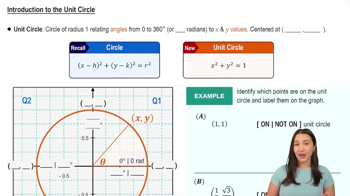
The unit circle is divided into four quadrants, each representing a range of angles. The first quadrant (0 to π/2) contains angles where both sine and cosine are positive. The second quadrant (π/2 to π) has positive sine and negative cosine, the third quadrant (π to 3π/2) has both sine and cosine negative, and the fourth quadrant (3π/2 to 2π) has positive cosine and negative sine. Understanding these quadrants is essential for determining the reference angle.
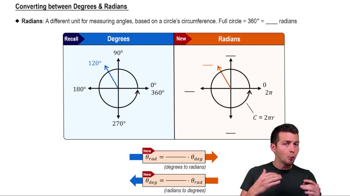
Angles can be measured in degrees or radians, with radians being the standard unit in trigonometry. One full rotation (360 degrees) is equivalent to 2π radians. To convert degrees to radians, multiply by π/180. When working with angles like 5π/4, recognizing that this angle is in radians helps in accurately determining its position on the unit circle and subsequently finding the reference angle.