Evaluate each expression. Give exact values.tan² 120° - 2 cot 240°
Verified step by step guidance
1
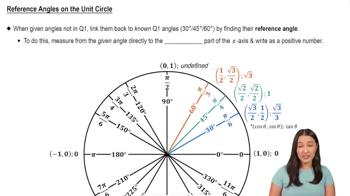
Convert the angles from degrees to radians if necessary. For example, 120° is \( \frac{2\pi}{3} \) radians and 240° is \( \frac{4\pi}{3} \) radians.
Find \( \tan(120°) \). Use the identity \( \tan(\theta) = \frac{\sin(\theta)}{\cos(\theta)} \) and the fact that \( \tan(120°) = \tan(180° - 60°) = -\tan(60°) \).
Square the result from the previous step to find \( \tan^2(120°) \).
Find \( \cot(240°) \). Use the identity \( \cot(\theta) = \frac{1}{\tan(\theta)} \) and the fact that \( \cot(240°) = \cot(180° + 60°) = \cot(60°) \).
Substitute the values found for \( \tan^2(120°) \) and \( \cot(240°) \) into the expression \( \tan^2(120°) - 2 \cot(240°) \) and simplify.
Verified video answer for a similar problem:
This video solution was recommended by our tutors as helpful for the problem above
Video duration:
7m
Play a video:
0 Comments
Key Concepts
Here are the essential concepts you must grasp in order to answer the question correctly.
Trigonometric Functions
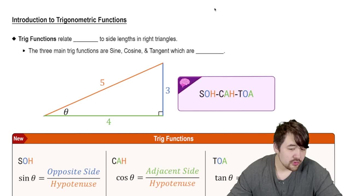
Trigonometric functions, such as tangent (tan) and cotangent (cot), relate angles to ratios of sides in right triangles. The tangent of an angle is the ratio of the opposite side to the adjacent side, while the cotangent is the reciprocal of the tangent. Understanding these functions is essential for evaluating expressions involving angles.
Angles in trigonometry can be measured in degrees, with a full circle being 360 degrees. The angles 120° and 240° are in the second and third quadrants, respectively, where the signs of trigonometric functions differ. Recognizing the quadrant of an angle helps determine the sign of the trigonometric function values.
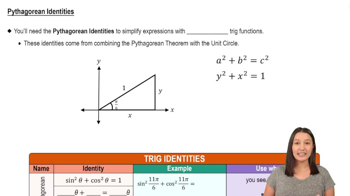
The Pythagorean identity states that for any angle θ, sin²(θ) + cos²(θ) = 1. This identity is fundamental in simplifying trigonometric expressions and can be used to derive other identities. It is particularly useful when evaluating expressions involving squares of trigonometric functions, such as tan²(θ).

 7:04 minutes
 Verified step by step guidance
 6:04
6:04