Ch. 2 - Acute Angles and Right Triangles
Lial - Trigonometry 12th Edition
Lial12th EditionTrigonometryISBN: 9780136552161Not the one you use?Change textbook
Chapter 3, Problem 42

Determine whether each statement is true or false. See Example 4. tan 28° ≤ tan 40°

Verified step by step guidance
1
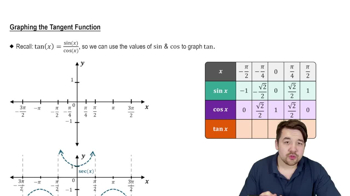
Recall that the tangent function, \(\tan \theta\), is increasing on the interval \(0^\circ < \theta < 90^\circ\) because it is positive and continuous there.
Since both \(28^\circ\) and \(40^\circ\) lie within the interval \(0^\circ\) to \(90^\circ\), we can compare their tangent values by comparing the angles directly.
Because \(28^\circ < 40^\circ\), and \(\tan \theta\) is increasing in this interval, it follows that \(\tan 28^\circ < \tan 40^\circ\).
Therefore, the inequality \(\tan 28^\circ \leq \tan 40^\circ\) is true, since the tangent of the smaller angle is less than the tangent of the larger angle.
To confirm, you could calculate approximate values of \(\tan 28^\circ\) and \(\tan 40^\circ\) using a calculator, but the reasoning based on the increasing nature of tangent in this interval is sufficient.

Verified video answer for a similar problem:

This video solution was recommended by our tutors as helpful for the problem above.
Video duration:
1m
Was this helpful?

Key Concepts

Here are the essential concepts you must grasp in order to answer the question correctly.

Properties of the Tangent Function

The tangent function, tan(θ), relates an angle in a right triangle to the ratio of the opposite side over the adjacent side. It is periodic and has vertical asymptotes at odd multiples of 90°. Understanding its behavior within the interval 0° to 90° is crucial for comparing values.
Recommended video:
5:43
Introduction to Tangent Graph

Monotonicity of Tangent in the First Quadrant

On the interval from 0° to 90°, the tangent function is strictly increasing, meaning that if angle A < angle B, then tan(A) < tan(B). This property allows direct comparison of tangent values for angles within this range.
Recommended video:
6:36
Quadratic Formula

Inequality Comparison of Trigonometric Values

To determine if an inequality involving trigonometric functions is true, one must understand how the function values change with the angle. For angles in the first quadrant, comparing the angles directly can help infer the inequality of their tangent values without calculating exact values.
Recommended video:
5:32
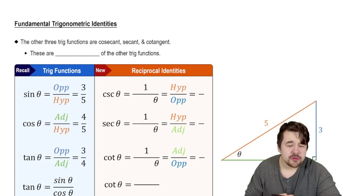
Fundamental Trigonometric Identities