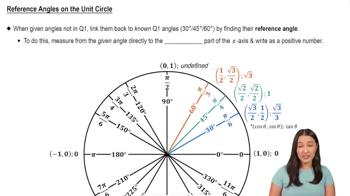
Understand that the reference angle is the acute angle formed by the terminal side of the given angle and the x-axis. Since the angle is given in radians, we will work with radians throughout.
First, simplify the given angle by reducing it within one full rotation (0 to 2\(\pi\)). To do this, find the equivalent angle \( \theta_{reduced} \) by subtracting multiples of \( 2\pi \) from \( \frac{16\pi}{3} \) until the angle lies between 0 and \( 2\pi \). Use the formula: \( \theta_{reduced} = \theta - 2\pi \times k \), where \( k \) is an integer.
Calculate \( k \) by dividing the given angle by \( 2\pi \): \( k = \left\lfloor \frac{16\pi/3}{2\pi} \right\rfloor \). Then subtract \( 2\pi k \) from the original angle to find \( \theta_{reduced} \).
Determine the quadrant in which \( \theta_{reduced} \) lies by comparing it to the standard quadrant boundaries: \( 0 \) to \( \frac{\pi}{2} \) (Quadrant I), \( \frac{\pi}{2} \) to \( \pi \) (Quadrant II), \( \pi \) to \( \frac{3\pi}{2} \) (Quadrant III), and \( \frac{3\pi}{2} \) to \( 2\pi \) (Quadrant IV).
This video solution was recommended by our tutors as helpful for the problem above
Video duration:
3m
Play a video:
0 Comments
Key Concepts
Here are the essential concepts you must grasp in order to answer the question correctly.
Radian Measure
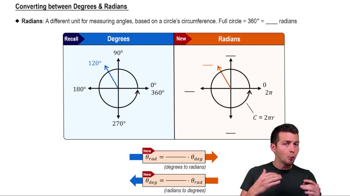
Radian measure is a way to express angles based on the radius of a circle. One radian is the angle subtended by an arc equal in length to the radius. Understanding radians is essential for converting and interpreting angles beyond the typical degree measure.
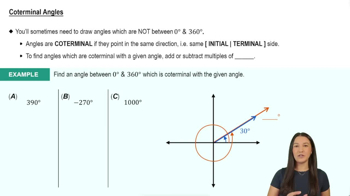
Coterminal angles are angles that share the same terminal side when drawn in standard position. They differ by full rotations of 2π radians. Finding coterminal angles helps simplify large angle measures by reducing them within a single rotation.
A reference angle is the acute angle formed between the terminal side of an angle and the x-axis. It is always between 0 and π/2 radians (0° and 90°) and is used to find trigonometric values for angles in different quadrants by relating them to the first quadrant.

 3:56 minutes
 Verified step by step guidance
 5:04
5:04