Ch. 1 - Angles and the Trigonometric Functions
Blitzer - Trigonometry 3rd Edition
Blitzer3rd EditionTrigonometryISBN: 9780137316601Not the one you use?Change textbook
Chapter 1, Problem 1.RE.55

In Exercises 49–59, find the exact value of each expression. Do not use a calculator. sin(-πœ‹/3)

Verified step by step guidance
1
Recall the definition of the sine function for negative angles: \(\sin(-\theta) = -\sin(\theta)\).
Identify the positive angle corresponding to the given negative angle: here, \(\theta = \frac{\pi}{3}\).
Use the identity to rewrite the expression: \(\sin\left(-\frac{\pi}{3}\right) = -\sin\left(\frac{\pi}{3}\right)\).
Recall the exact value of \(\sin\left(\frac{\pi}{3}\right)\), which is \(\frac{\sqrt{3}}{2}\).
Substitute this value back into the expression to get \(\sin\left(-\frac{\pi}{3}\right) = -\frac{\sqrt{3}}{2}\).

Verified video answer for a similar problem:

This video solution was recommended by our tutors as helpful for the problem above.
Video duration:
3m
Was this helpful?

Key Concepts

Here are the essential concepts you must grasp in order to answer the question correctly.

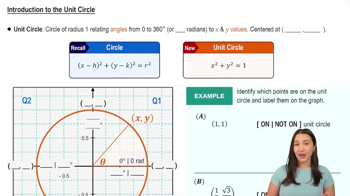
Unit Circle and Angle Measurement

The unit circle is a circle with radius 1 centered at the origin of the coordinate plane. Angles are measured in radians, where πœ‹ radians equal 180 degrees. Understanding the position of angles like -πœ‹/3 on the unit circle helps determine the sine value based on the y-coordinate of the corresponding point.
Recommended video:
06:11
Introduction to the Unit Circle

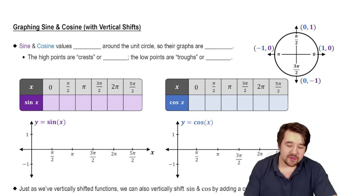
Sine Function and Its Properties

The sine function relates an angle to the y-coordinate of a point on the unit circle. It is an odd function, meaning sin(-ΞΈ) = -sin(ΞΈ). This property allows simplification of sine values for negative angles by converting them to positive angles and then negating the result.
Recommended video:
5:53
Graph of Sine and Cosine Function

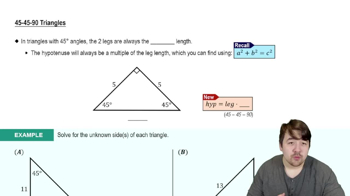
Exact Values of Special Angles

Certain angles, such as πœ‹/3, πœ‹/4, and πœ‹/6, have well-known exact sine values derived from special right triangles. For πœ‹/3, sin(πœ‹/3) = √3/2. Using these exact values avoids approximation and calculator use, enabling precise answers in trigonometric problems.
Recommended video:
04:39
45-45-90 Triangles