Graph each function. See Examples 1 and 2.ƒ(x) = 3|x|
Verified step by step guidance
1
Step 1: Recognize that the function \( f(x) = 3|x| \) is a transformation of the basic absolute value function \( g(x) = |x| \).
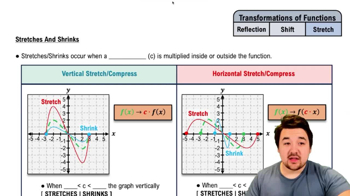
Step 2: Understand that the coefficient 3 in front of \(|x|\) indicates a vertical stretch of the graph by a factor of 3. This means that for every point \((x, y)\) on the graph of \(g(x) = |x|\), the corresponding point on \(f(x) = 3|x|\) will be \((x, 3y)\).
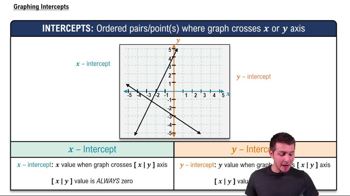
Step 3: Identify the vertex of the graph. Since there are no horizontal or vertical shifts, the vertex remains at the origin \((0, 0)\).
Step 4: Plot key points. For example, calculate \(f(x)\) for \(x = -1, 0, 1\) to get points \((-1, 3), (0, 0), (1, 3)\).
Step 5: Draw the graph by connecting the points with straight lines, forming a 'V' shape that opens upwards, with the vertex at the origin and the arms of the 'V' being steeper than those of \(g(x) = |x|\) due to the vertical stretch.
Verified video answer for a similar problem:
This video solution was recommended by our tutors as helpful for the problem above
Video duration:
6m
Play a video:
0 Comments
Key Concepts
Here are the essential concepts you must grasp in order to answer the question correctly.
Absolute Value Function
The absolute value function, denoted as |x|, outputs the non-negative value of x regardless of its sign. This means that for any real number x, |x| is equal to x if x is positive or zero, and -x if x is negative. Understanding this function is crucial for graphing, as it creates a V-shaped graph that opens upwards, reflecting the symmetry about the y-axis.
Evaluate Composite Functions - Values Not on Unit Circle
Vertical Stretch
A vertical stretch occurs when a function is multiplied by a constant factor greater than one. In the function ƒ(x) = 3|x|, the factor of 3 stretches the graph vertically by a factor of 3, making it steeper than the basic absolute value function. This transformation affects the y-values of the function, increasing them proportionally while maintaining the overall shape of the graph.
Graphing techniques involve plotting points and understanding transformations to visualize functions accurately. For ƒ(x) = 3|x|, one can start by plotting key points such as (0,0), (1,3), and (-1,3), then connect these points to form the V-shape. Familiarity with transformations, such as shifts and stretches, is essential for accurately representing the function on a coordinate plane.