Step 1: Start by finding the measure of angle B. Since the sum of angles in a triangle is 180°, use the formula: B = 180° - A - C.
Step 2: Substitute the given values for angles A and C into the formula: B = 180° - 39.70° - 30.35°.
Step 3: Calculate the measure of angle B using the values from Step 2.
Step 4: Use the Law of Sines to find the length of side a. The Law of Sines states: \( \frac{a}{\sin A} = \frac{b}{\sin B} \).
Step 5: Rearrange the Law of Sines formula to solve for a: \( a = b \cdot \frac{\sin A}{\sin B} \), and substitute the known values to find a.
Verified video answer for a similar problem:
This video solution was recommended by our tutors as helpful for the problem above
Play a video:
0 Comments
Key Concepts
Here are the essential concepts you must grasp in order to answer the question correctly.
Triangle Sum Theorem
The Triangle Sum Theorem states that the sum of the interior angles of a triangle is always 180 degrees. In this problem, knowing two angles (A and C) allows us to find the third angle (B) by subtracting the sum of A and C from 180 degrees. This is essential for solving the triangle as all angles must be known.
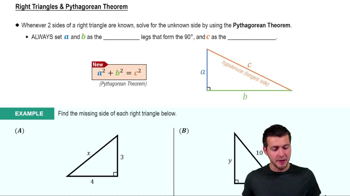
Solving Right Triangles with the Pythagorean Theorem
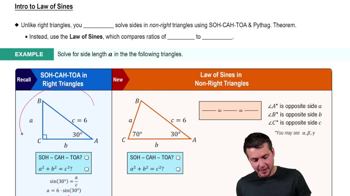
Law of Sines
The Law of Sines relates the lengths of the sides of a triangle to the sines of its angles. It states that the ratio of a side length to the sine of its opposite angle is constant for all three sides. This law is particularly useful in this problem to find the unknown sides of triangle ABC once all angles are determined.
Understanding side-angle relationships is crucial in trigonometry, especially in non-right triangles. In triangle ABC, knowing one side (b) and two angles (A and C) allows us to determine the lengths of the other sides using the Law of Sines. This concept is fundamental for solving triangles when not all sides and angles are initially known.