Ch. 1 - Angles and the Trigonometric Functions
Blitzer - Trigonometry 3rd Edition
Blitzer3rd EditionTrigonometryISBN: 9780137316601Not the one you use?Change textbook
Chapter 1, Problem 39

In Exercises 39–40, let θ be an angle in standard position. Name the quadrant in which θ lies.
tan θ > 0 and sec θ > 0

Verified step by step guidance
1
Recall the signs of trigonometric functions in each quadrant: In Quadrant I, all functions are positive; in Quadrant II, sine is positive while cosine and tangent are negative; in Quadrant III, tangent is positive while sine and cosine are negative; in Quadrant IV, cosine is positive while sine and tangent are negative.
Analyze the given conditions: \( \tan \theta > 0 \) means tangent is positive, which occurs in Quadrants I and III.
Next, consider \( \sec \theta > 0 \). Since \( \sec \theta = \frac{1}{\cos \theta} \), this means \( \cos \theta > 0 \). Cosine is positive in Quadrants I and IV.
Find the quadrant(s) where both conditions are true simultaneously: tangent positive (Quadrants I and III) and cosine positive (Quadrants I and IV). The only quadrant common to both is Quadrant I.
Therefore, \( \theta \) lies in Quadrant I.

Verified video answer for a similar problem:

This video solution was recommended by our tutors as helpful for the problem above.
Video duration:
1m
Was this helpful?

Key Concepts

Here are the essential concepts you must grasp in order to answer the question correctly.

Signs of Trigonometric Functions in Quadrants

Each quadrant of the coordinate plane has specific signs for sine, cosine, and tangent functions. Knowing these sign patterns helps determine the quadrant of an angle based on the given trigonometric values.
Recommended video:
6:36
Quadratic Formula

Definition and Sign of Tangent Function

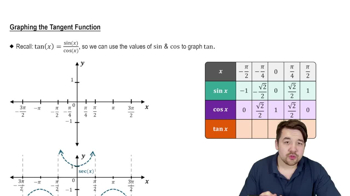
Tangent of an angle θ is the ratio of sine to cosine (tan θ = sin θ / cos θ). Its sign depends on the signs of sine and cosine, being positive when both have the same sign, which occurs in Quadrants I and III.
Recommended video:
5:43
Introduction to Tangent Graph

Definition and Sign of Secant Function

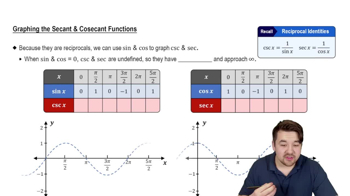
Secant is the reciprocal of cosine (sec θ = 1 / cos θ). The sign of secant matches the sign of cosine, so sec θ > 0 means cosine is positive, which happens in Quadrants I and IV.
Recommended video:
6:22
Graphs of Secant and Cosecant Functions