Determine the complementary angle: \( \frac{\pi}{2} - \frac{2\pi}{5} \).
Simplify the expression for the complementary angle: \( \frac{\pi}{2} - \frac{2\pi}{5} = \frac{5\pi}{10} - \frac{4\pi}{10} = \frac{\pi}{10} \).
Express \( \sin(\frac{2\pi}{5}) \) in terms of its cofunction: \( \cos(\frac{\pi}{10}) \).
Verified video answer for a similar problem:
This video solution was recommended by our tutors as helpful for the problem above
Play a video:
0 Comments
Key Concepts
Here are the essential concepts you must grasp in order to answer the question correctly.
Cofunction Identities
Cofunction identities relate the trigonometric functions of complementary angles. For example, the sine of an angle is equal to the cosine of its complement: sin(θ) = cos(90° - θ). This principle is essential for rewriting trigonometric functions in terms of their cofunctions, particularly when dealing with angles that sum to 90 degrees.
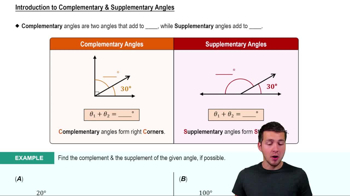
Complementary angles are two angles whose measures add up to 90 degrees. In trigonometry, understanding complementary angles is crucial for applying cofunction identities. For instance, if θ is an angle, then 90° - θ is its complement, which allows for the transformation of trigonometric expressions involving sin and cos.
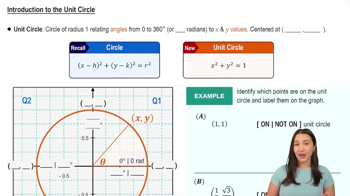
The unit circle is a fundamental concept in trigonometry that defines the values of sine and cosine for various angles. It is a circle with a radius of one centered at the origin of a coordinate plane. By using the unit circle, one can easily find the sine and cosine values for angles, including those expressed in radians, such as 2π/5.

 Verified step by step guidance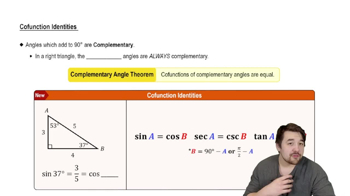
 6:30
6:30