Find the exact value of each expression. tan (-7π/12)
Verified step by step guidance
1
Recognize that the angle is negative and given in radians: \(-\frac{7\pi}{12}\). Recall that tangent is periodic with period \(\pi\), so you can add \(\pi\) to the angle to find a coterminal angle in the standard interval: \(-\frac{7\pi}{12} + \pi = -\frac{7\pi}{12} + \frac{12\pi}{12} = \frac{5\pi}{12}\).
Rewrite the angle \(\frac{5\pi}{12}\) as a sum or difference of angles whose tangent values are known. For example, \(\frac{5\pi}{12} = \frac{\pi}{3} - \frac{\pi}{4}\).
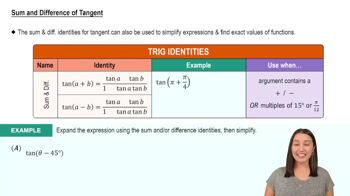
Use the tangent difference identity: \(\tan(a - b) = \frac{\tan a - \tan b}{1 + \tan a \tan b}\). Substitute \(a = \frac{\pi}{3}\) and \(b = \frac{\pi}{4}\).
Recall the exact values: \(\tan \frac{\pi}{3} = \sqrt{3}\) and \(\tan \frac{\pi}{4} = 1\). Substitute these into the formula to get \(\tan \left( \frac{\pi}{3} - \frac{\pi}{4} \right) = \frac{\sqrt{3} - 1}{1 + \sqrt{3} \times 1}\).
Simplify the expression \(\frac{\sqrt{3} - 1}{1 + \sqrt{3}}\) by rationalizing the denominator if needed to find the exact value of \(\tan \left(-\frac{7\pi}{12}\right)\).
Verified video answer for a similar problem:
This video solution was recommended by our tutors as helpful for the problem above
Play a video:
0 Comments
Key Concepts
Here are the essential concepts you must grasp in order to answer the question correctly.
Reference Angles and Angle Reduction
To find the exact value of trigonometric functions for angles outside the standard range, we use reference angles by adding or subtracting full rotations (2π) or using angle identities to bring the angle within a familiar interval. For example, converting -7π/12 to a positive coterminal angle helps simplify evaluation.
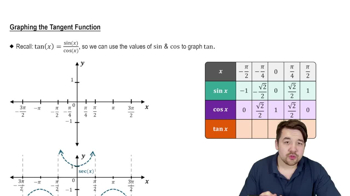
The tangent function has a period of π, meaning tan(θ) = tan(θ + π). This property allows us to simplify angles by adding or subtracting multiples of π to find equivalent angles with the same tangent value, facilitating easier calculation of exact values.
The tangent of a sum or difference of angles can be expressed as tan(a ± b) = (tan a ± tan b) / (1 ∓ tan a tan b). This formula is useful for breaking down complex angles like 7π/12 into sums or differences of special angles (e.g., π/3 and π/4) whose tangent values are known exactly.

 Verified step by step guidance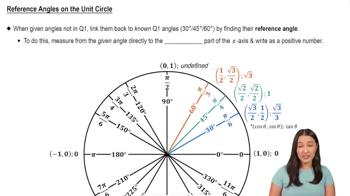
 5:31
5:31