Graph each function. See Examples 6–8.g(x) = (x - 4)²
Verified step by step guidance
1
Identify the basic form of the function: The given function is \( g(x) = (x - 4)^2 \), which is a quadratic function in the form \( (x - h)^2 + k \) where \( h = 4 \) and \( k = 0 \).
Determine the vertex of the parabola: Since the function is in the form \( (x - h)^2 + k \), the vertex is at the point \( (h, k) = (4, 0) \).
Identify the direction of the parabola: The coefficient of \( (x - 4)^2 \) is positive, indicating that the parabola opens upwards.
Plot the vertex on the graph: Place a point at \( (4, 0) \) on the coordinate plane.
Sketch the parabola: Since the parabola opens upwards, draw a symmetric curve with the vertex at \( (4, 0) \), ensuring it is wider as it moves away from the vertex.
Verified video answer for a similar problem:
This video solution was recommended by our tutors as helpful for the problem above
Video duration:
5m
Play a video:
0 Comments
Key Concepts
Here are the essential concepts you must grasp in order to answer the question correctly.
Quadratic Functions
A quadratic function is a polynomial function of degree two, typically expressed in the form g(x) = ax² + bx + c. The graph of a quadratic function is a parabola, which can open upwards or downwards depending on the sign of the coefficient 'a'. Understanding the general shape and properties of parabolas is essential for graphing functions like g(x) = (x - 4)².
The vertex of a parabola is the highest or lowest point on the graph, depending on its orientation. For the function g(x) = (x - 4)², the vertex can be found at the point (4, 0), which represents the minimum value of the function. Identifying the vertex is crucial for accurately graphing the function and understanding its behavior.
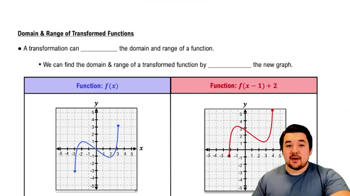
Transformations involve shifting, stretching, or reflecting the graph of a function. In the case of g(x) = (x - 4)², the function is a transformation of the basic quadratic function f(x) = x², shifted 4 units to the right. Recognizing these transformations helps in predicting the graph's position and shape relative to the parent function.